

There is an old story about Nasrudin, a character in a number of Sufi stories, who is searching for his keys under a street light. One of his friends comes along and asks him what he is doing. When he finds out that Nasrudin is looking for his keys, the friend joins him in the search. After a thorough search of the lighted area, the friend asks Nasrudin if he is sure that he lost his keys here. Nasrudin says, “No, I lost them in my garden.” Then the friend asks, “Then why are you looking for them here?” Whereupon Nasrudin explains, “Well, this is where the light is.”
Perhaps we are looking in the wrong place for success in our efforts to stop smoking. If we are, then it is no wonder that we are not very successful. You see, everybody is a non- smoker, that is, at least while they are sleeping. If people only took the same approach (doing nothing with regard to smoking) while they were awake, they would continue to be non-smokers. Unfortunately, some people do something when they wake up (in this case, it is called lighting up and smoking). The people who do this “something” are called smokers. The people who don’t are called non-smokers. The ease of doing nothing in regard to smoking is so apparent, so patently obvious, that most people miss it altogether. This blog deliberately aims to point out the obvious, which somehow manages to be “invisible” to most people.
Let me begin by saying that many smoking cessation programs end up with people still smoking. Or people may take a short break, only to return to the practice of smoking because they have not changed their thought patterns. To me, the funny thing is that these programs are aimed in the direction of hard work, will power, and struggle—none of which seems to work very well. As an alternative, I would like to present a view that you could use, in an easy and simple manner, to become a permanent non-smoker. I also would like to include some humor. Later on, in reading this, when you see the joke, you may suddenly realize that you have been going at the process of stopping smoking backwards, even though “normally.” Then you can laugh and “disappear” smoking as an issue. In a nutshell, the only way that you can experience smoking as a problem is to create it to be a problem. If you stop creating the problem, you will not be able to experience it as a problem. Hence, you will “disappear” it—Poof! Thus, the reason I have used quotation marks around “disappearing” is to alert you to the notion that “disappearing” can mean not creating (or, if you prefer, “not appearing”). If this isn’t very clear now, I am quite sure you will “understand” better by the time you finish reading this.
Perhaps one way of clarifying my point is to say that if we have tried the things that don’t work, we might be well advised to try a different approach. The solution is most likely to be found in the realm of possibilities that we haven’t tried. In my smoking cessation “play shops,” I use a puzzle to illustrate my point. The puzzle, in case you are not familiar with it, is about nine dots arranged in a square as follows:
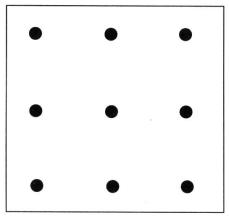
The task is to connect all nine dots using four straight lines without lifting the pencil off the paper. If you haven’t seen this puzzle or don’t remember the solution, take a moment to trace some possibilities. If you are like most people, you will begin by going around the eight perimeter dots, which leaves the center dot unconnected. From there, most people make various diagonals and still miss one or two dots.
As you attempt this puzzle, you may unknowingly impose a limitation on yourself that makes the puzzle insoluble. Without the limitation, the puzzle is easily and simply solved. What is most important to realize is that you are not aware of the self-imposed limitation. When the limitation is outside of awareness, the limitation is essentially “invisible.” Once you become aware of another option, you will quickly recognize that the limitation is not imposed by the way the puzzle is set up but rather by an unwitting assumption on your part.
Of course, another way of expressing this situation is that if you are looking for the keys where they aren’t, you won’t find them. You need to look where they are! Similarly, we may be looking for ways of stopping smoking in a direction that is not productive or where we have unwittingly limited ourselves from succeeding. The issue of stopping smoking may be a result of the way we “hold” the problem conceptually. We may have created self-administered limitations that are outside of our awareness. When we “hold” the situation differently or remove the limitation through expanding our awareness, we may simply “disappear” the issue.
In case you haven’t arrived at the solution to the puzzle, let me share the answer with you. If you already know, you can skip this paragraph. Begin at one corner, say the upper left, and go straight across to your right, connecting the top three dots, however, do not stop there. Continue the line to extend approximately the distance between dots two and three. Then make a 45 degree angle downward and connect the right hand dot in the middle row and the middle dot of the bottom row. Once again, do not stop there but continue on until you are directly below the three dots in the left hand column. Then make a 45 degree angle upward and go up through the two unconnected dots in the left hand column. When you reach the beginning point (top left dot), make another 45 degree angle downward to the right and connect the remaining two dots with that diagonal.
As you follow these directions, you are likely to discover that you had unwittingly restricted yourself to the area bounded by the nine dots. It probably did not occur to you to go “outside the nine dots.” Once you are aware of looking at the problem differently , then the problem ceases to exist. It “disappears.” Poof!
If you want to take a short cut, here is what the completed figure would look like:

Perhaps the difficulty of stopping smoking may also be the result of self-imposed limitations that are outside our awareness. Perhaps the difficulty is due to the way we “hold” the problem conceptually. If we go outside these conceptual boundaries, we may “disappear” the issue simply, easily, and quickly. To explore the area “outside the nine dots” is the purpose of this manuscript.
One of the first items to examine is the notion of self mastery. Most people limit themselves unwittingly by assuming that they do not yet have self-mastery. Also, most programs (and psychologists) focus on “gaining” self mastery, as if the person were not already in charge. This view is limiting when compared to the assumption that we are “stuck with” self-mastery. In other words, there is nobody in here except me and nobody in there except you. You run you and I run me. We do not need to attain self-mastery since we already have it. This eliminates the “struggle” for self mastery. We can go directly to the next step, which is deciding how we want to use our sovereignty and self mastery, positively or negatively. I think it is funny that our self-mastery is so complete that we can use it to pretend that we don’t have it. What a curious state of affairs!
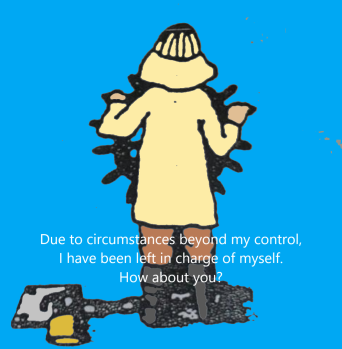
From this point of view, smoking is clear evidence of self mastery! Not smoking is clear evidence of self-mastery! Which direction do you want to use your self-mastery? Reading this and “disappearing” smoking as an issue is clear evidence of self-mastery. Reading this and continuing your struggle to stop smoking is clear evidence of self-mastery. Going to work is clear evidence of self-mastery. Not going to work is clear evidence of self-mastery. There is nothing else. I don’t know if my statement is right or wrong (and it doesn’t matter), but I know that this assumption has great utility for a gentle and effective self-management strategy. Another way of saying this is that I am going “outside the nine dots” to resolve the puzzle of smoking cessation. My thinking is different from what it used to be and it is different from what most psychologists “make up.”
When I was “normal” and a smoker, I used to tell myself that I had to stop smoking. Of course, this was not true; I didn’t have to stop smoking. I used to tell myself that I wished I could stop smoking but couldn’t. This wasn’t the case, except when I believed it. I used to attempt scaring myself into stopping smoking and I simply wanted a few more smokes before I stopped. I used to bribe myself and that didn’t work either. I was unaware that I was approaching the situation with self-limiting assumptions about who I was and who was sovereign within me. I was looking for the keys where they weren’t!
Before going any further, I would like to share with you some information about my background. I created (“appeared”) an issue or problem with smoking for approximately 20 years. I tried hard to stop from time to time, but only succeeded in failing and discouraging myself. I knew smoking was not good for my health, and yet despite the evidence, I continued. I switched to pipes for a while but when my suit jacket pockets began to look like saddlebags and I got dirty looks from people who asked if I were smoking rubber bands, I went back to cigarettes. On occasion, I also switched to cigars. However, I smoked them more like cigarettes than cigars. In other words, I inhaled them, and I smoked a lot of them. Then I would return to smoking cigarettes—approximately two packs a day. I became thoroughly discouraged about my lack of will power since I thought I couldn’t make myself accomplish a simple thing like stopping smoking.
Well, wonder of wonders, approximately nine years ago (now sixteen years ago), I “disappeared smoking” as an issue. Now I smoke during one week of the year. Every year about the end of June and the beginning of July, I smoke about a carton of Kool Filter Kings in approximately one week. Then, I don’t smoke until the following June. (As an update, I now smoke about half a carton of Benson & Hedges). As you can gauge by your own reaction to this, my smoking behavior does not fit the usual pattern. Many people will immediately ask why I do this, and others will ask how. I am not going to go into why, at least at this point, because it would likely be distracting to your appreciation of the ease and simplicity of not smoking.
When I get the “How do you do that?” question, typically from smokers, I indicate that I buy a package of Kools, open it up, take one out, light it and puff on it intermittently until it gets short, and then I stub it out. A few minutes later, I repeat the process and so on until I have finished the pack. Then I crumple up the empty pack and dispose of it. Later, I go through the same process with another pack, one cigarette at a time, at varying intervals. I do this with 9, 10, or 11 packs and then I don’t light up for 51 weeks. Simply put, that is how I do it.
When people who smoke ask how I do it, I ask them if they smoke all 52 weeks a year. If the response is affirmative, I ask them, “How do you do it?” Usually they look sheepish and realize that they do exactly the same thing as I do. Except they continue to light up every day at varying intervals for 52 weeks a year.
The only difference between their behavior and mine is in the amount of time devoted to lighting up. However, their thought processes (mental behavior) seem to be very different from mine. In fact, their thinking seems pretty much like what I used to think and believe 10 to 30 years ago. Mentally, smokers seem to believe that they can’t stop. They believe they are helpless victims of their habit. Of course, their behavior has to substantiate, support, or conform to their belief. In other words, if they believe that they can’t stop, then this becomes true! They can’t stop—at least with that belief system in operation. What I make up—I believe that I can stop smoking for 51 weeks of each year, easily and simply—is also true (at least for me). As a result, my behavior in regard to smoking has to follow my belief system.
Now that we are talking about belief systems, I want to point out that belief systems are made up. We make them up! They are simply a bunch of words—at least that is what I say to myself when I make them up. What do you make up about that? As a result of what I have made up, I feel totally in charge of myself in regard to smoking. I believe I can smoke only one week out of 52, and then I do it. What I would like to point out is that even at this moment, you are making up your own reactions, your own beliefs about what I have written. (So, why don’t we own our own beliefs, reactions and behaviors?)
At this point, you may be making up an ineffective belief in terms of helping you join the ranks of the non- smokers. Or, stated in reverse, you may be extremely effective in terms of making up a belief that you use to continue your smoking. Since belief systems are simply composed of words, and you are the only one “inside your skin,” you are also free to make up whatever you want to believe now. This is true even if this belief is different from what you made up yesterday or the day before. After all, who could stop you from making up whatever belief system you want? You are in charge of that for you!
As you can see, we are venturing into the belief system about belief systems, although that is also a belief system! Each individual makes up his or her own belief. Hence, all belief systems are subject to each individual’s sovereignty.
In regard to smoking, I began to look at it differently. I remembered that I had absolutely no difficulty stopping smoking. If I smoked 40 cigarettes a day, I stopped smoking 40 times a day. With ease and simplicity, I just stubbed out the butt. But you may say, you didn’t really stop. Well, I did, because when I am not smoking, I am not smoking. On the other hand, you are right, because I did not stay stopped, I later lit up again. So I made up that the issue was not stopping, rather it was lighting up. I had suddenly made up what is called a realization: stopping smoking was not the issue (since it was so easy and simple to do). Instead, the issue was about lighting up (which turns out to be easy and simple also). I made up a rather fundamental realization (or belief) when I “saw” that if I never lit up again, I would never smoke again. Utter simplicity! I just hadn’t made it up that way before.
Now the next thought I made up was that when I looked at not lighting up, I could call that doing nothing, or doing no thing, if you prefer. This is the very essence of simplicity, doing nothing or no thing in regard to smoking. To expand on this I would like to share three other realizations that I made up.
First was the realization that I had never smoked without using these things that we call hands. Second, was the realization that these things we call hands were directly connected to me via these things we call arms. Third, was the realization that together these appendages only did exactly what I told them to do. In other words, I am in charge of my hands, just as surely as a car is steered by the driver. So then, if I am in command, and if I didn’t tell my hands to do anything, they wouldn’t. In fact, they couldn’t. Instead, they would be idle, awaiting my next command. Another way of describing this situation is “doing nothing” or “no thing.” Moreover, if my hands and arms stayed in that position (idle or doing nothing) for the rest of my life, it would be obvious that I would never smoke again.
On the other hand (no pun intended), if my hands never did anything again, this would mean radically limiting my eating, typing, scratching, in fact, all my manual behaviors as well. Since I am in charge of my hands, I make up that I will issue them the commands of combing my hair, putting on my glasses, scratching my ear, feeding my face, etc. As you can readily see in a computer analogy, I am going to design a program with 9,788 (or whatever number suits you) commands that I want my hands to accomplish. But, the key here is that I am simply going to leave out one command, and that is, lighting up.
That sounds pretty simple, doesn’t it? In fact, it sounds too simple for most people’s belief system about ease and simplicity. Most people in this culture, if they are “normal,” are somewhat distrustful and skeptical about ease and simplicity. It simply doesn’t fit into the puritanical norms that have been left over from our founding fathers and mothers. Can you believe that people will not accept a useful belief system just because they believe it to be too easy? I’ll bet you can’t believe that! Or can you?
Anyway, in either case it is up to you. Or better said, you, yourself, are up to you. Your behavior (smoking) can be seen as the print out, the result of your program (belief system). From this vantage point, it is fairly obvious that one quick and easy way to change behavior is to “play around with” your present programs or belief systems. Notice that I say, “play around with” rather than “work hard to change” them. Since belief systems are just a collection of words, we can make up any collection of words we want to describe them, can’t we? What are the words that you make up in response to that question?
At this point, many of you will respond with the words, “That’s easier said than done.” Frankly, I am not sure just what that response is supposed to mean. What I do know is that many people use that sentence to dismiss a potentially useful belief system. They believe they have no choice, other than to struggle and strain if they want to implement personal change. Yet they are exercising choice when they choose to dismiss a potentially useful belief system with the sentence: “That’s easier said than done.” In addition, they tend to review previous failures in their attempts to change. This review usually results in their further reinforcing their belief system about belief systems.
Why not look at it another way? When it comes to doing nothing, what actually could be easier? Since you are the operator of you (there is nobody in there except you), who could stop you from doing nothing regarding smoking? Think about that. What could be easier than “doing nothing” or “no thing”?
At this point, many people will make up a series of so-called “normal” reactions called “Yes, but ….” For example, “Yes, but what about withdrawal?” or “Yes, but what about physical symptoms?” or “Yes, but what about habit?” or even better, “Yes, but what about ‘the urge’?”
Let me begin with what people make up about withdrawal. “Normal,” puritanically oriented folks are going to focus on the difficulty of “enduring” the physical symptoms that are called “withdrawal.” They have a belief system that says change is really tough, or put more succinctly, “No pain, no gain.” If you believe this, you are likely to tense up and get ready for the inevitable struggle. What is funny is that the more you tense up, the more you are likely to create what is called the urge to smoke. This is because you have developed a belief and a pattern of using smoking as a way to ease tension. Let’s examine that belief system, when we assault our lungs with smoke. What is amazing, is that if we say (believe) that smoking is relaxing, it is. And it is true, it really is. I know it is true because I used to make it up that way myself. If that isn’t an exquisite demonstration of our control over our own belief system and our own behavior, I don’t know what is.
Let me offer an alternative. What if we labeled “withdrawal” as something else? Wouldn’t that change our experience? Certainly, if we believed it, it would. So here is one analogy. On many occasions, I have been seated with one leg under me. Occasionally, I will sit that way long enough, so that my leg goes to sleep. When I begin to stand up, I am very aware that my leg is asleep because I experience “pins and needles” in my leg, and I don’t trust putting my full weight on it. In just a few minutes, my leg is “fully awake” and I walk off without any undesirable consequences.
What if we “played around with” the reactions we experience when we stop ingesting nicotine, tar, etc., and viewed all those “changes” in our body as “pins and needles,” or symptoms of our body waking up? Every time we experience some kind of twinge or odd sensation, we could simply say, “Oh good, my body is waking up.” If we did that for 3 or 4 days (instead of the 3 or 4 minutes needed for a leg to wake up), then we could feel very positive about our body sending us reassuring signals that it is waking up. And once again, who could stop us from making it up that way? Remember, we are the only ones inside us! So, yes, there are physical symptoms (feedback), much like when our leg “wakes up.”
Next, let’s look at the concept of habit, an abstraction that somebody made up a long time ago. If we think back to an extremely long time ago, when there might have been only one or two hundred words in our primitive vocabulary, I would bet “habit” was not one of them. Probably the only words were nouns to designate things (like tree, water, tiger) and verbs to designate actions (like run, look, cook). When a word represents an abstraction, it means that we can’t see it, touch it, taste it, lift it, or put it in a wheelbarrow. However, despite this lack of tangibility, we can believe in it enough so that we can create our own experience of it. In other words, a habit is not concrete. We can’t weigh a habit so that we can say: “that is a two pound habit” or “that is a sixteen pound habit.” Instead, we need faith in our belief about habits (note that all of these words are abstractions) in order to experience it.
Of course, this does not seem like an abstraction to the individuals who are creating and experiencing their “habit,” but it is abstract to those around them. In order for those around them to get any idea of the “strength” of a habit, they have to see frowning, hear groaning, see perspiration, hear whining and complaining. (The equation that we have made up seems to be: the louder the groaning and complaining, the stronger the habit.) Those are all possible actions, which the person with the “strong” habit is only too eager to provide.
Is there a word we could use to change our experience of habit as an abstraction? Let me suggest using the word “pattern,” an abstraction that doesn’t have as many disadvantages as habit. We can use pattern to describe some activity that we do regularly, for example, smoking. However, when we say we have a “pattern” of smoking, somehow we don’t conjure up our old concepts of “strength” or “morality” as we do when we use the word “habit.” This becomes especially obvious when we add the word “bad” to habit. Habits have strength (in our belief system) and if you have been doing something for a long time (smoking), then supposedly the habit is much stronger than if it were new—since it depends on the number of repetitions. I might add that we seem to be oblivious to how well practiced we are at stopping smoking. We make one stop for every start, or we couldn’t ever start (light up) again.
We can even invoke the strongest notion of habit by calling a habit an addiction. When we go that far, we have given ourselves an extra benefit, if we want to continue smoking. This gives us a chance to see ourselves as “addicts,” and now we see the “addiction” as being in control. The addiction makes us do things that we don’t want to do. Now we believe the whole thing is out of our hands, even though the cigarette is in our own hands. Now we can also believe we need outside help, lots of outside help to “regain control” of ourselves.
All of this reminds me of an advertisement from a local hospital that runs a smoking cessation program. The first written line under the picture of somebody smoking is “How to quit smoking.” Beneath that line, in slightly smaller letters, are the words: “The first step: admit you’re hooked.” Now think about that sentence. As a first step, that seems pretty ridiculous. When a fish is hooked, the fisherman, who is somebody other than the fish, is in charge. The fish itself is relatively helpless and dependent. So when we translate the meaning of “being hooked,” it suggests that we freely use our choice and our freedom to say that we are not free. Instead, we wind up saying that we are hooked and helpless. In other words, the cigarette, our habit, our addiction, etc., is in charge or in control of us. The ad requires that we do not see it as the other way around. The message in this ad is that you need “outside help” to stop smoking—you can’t do it by yourself. (By the way if you own your behavior, who else can act for you?)
However, if we use our choice to substitute pattern for habit or addiction, then we are closer to operating under the illusion of choice and freedom, rather than under the illusion of no choice and no freedom. If we refer to a typical way of doing something as a pattern, not a habit, we tend to believe that we can change that more easily. For example, most of us could drive some alternative route to work even though we may have driven the same route for twenty years. We could have our orange juice after our coffee instead of before, no matter how long we have had the juice first. As I use these examples, many people may dismiss them as trivial and easy to change. Well, wouldn’t it be useful to look at smoking through a similar belief system? In other words, we could say that changing our smoking pattern is also trivial and easy! If you did this, who could stop you, even though it would be “abnormal” to think this way? If you “played around with” this way of viewing things, you might even begin laughing about what a needless struggle you had been creating for yourself. And, since laughter is the best medicine, you might immediately (even quicker than lighting up a cigarette) feel better and more relaxed. By laughing at ourselves and relaxing, we reduce the so-called “need” or for a cigarette.
“Urge” is another abstraction worthy of discussion. We have a set of neurons in our nervous system called the Reticular Activating System (RAS), which has the function of amplifying signals that we are interested in and want to attend to. The RAS also can reduce the signals that we are not interested in attending to at a given time. If we try hard to stop smoking (thereby struggling and tensing), then we become more interested in having a cigarette. We “make up” an increased alertness to other people smoking, cigarette ads, telephones ringing, etc., what many people call “triggers” that “set off’ our “habit” or “addiction.” You can readily see the implicit victim or addict belief system. When people put themselves in this posture, they believe the environment is controlling them.
At this point, each time we reach in our pocket or purse for a cigarette without thinking (or outside of our awareness), we can laugh and remember to do nothing about smoking! The more often we reach, the more we practice! What is interesting, is that if we chuckle at ourselves, we can feel good immediately. That way we can experience a positive feeling even faster than lighting a cigarette. Incidentally, this positive feeling doesn’t have negative “side effects” like smoking does. As we play the game by choosing that response, we will soon experience a reduction of our interest in cigarettes, since they become less and less relevant to us.
Another abstraction I would like to mention is procrastination. Recently, I was talking to a client who said that he would like to stop smoking but that he has been procrastinating. I said, “You obviously haven’t been procrastinating enough.” He looked at me in a peculiar way and said he didn’t understand. I said, “If you used procrastination for you, instead of against you, you would not be smoking.” Again, he blinked and I continued, “If you procrastinated lighting up long enough, you would see that you wouldn’t need to stop smoking.” Once again, this is too simple and too obvious. Therefore it can’t work, right? Never mind the utility or effectiveness of the strategy!
Since I have been clear all along that I am only making this up, I want to urge you again not to take me seriously. I simply invite you to play around with these concepts. You might end up being as “abnormal” as I am. Remember, the reason I do not smoke 51 weeks of the year is because I am not doing anything at all about smoking (another way of saying I am doing nothing or no thing). There is only one week of the year that I do anything at all about smoking and that is the week I smoke. Do you “see” the connection?
One of the “side effects” of this approach to “disappearing smoking” is that you might even end up with a very positive feeling about yourself (called high self-esteem). This “side effect” usually follows when we are operating from the position of choice. In other words, I run me and you run you. In the contrasting position, we are victims and other people and other things, outside our control, run us.
I want to hasten to add that I am not especially for or against smoking. I am not taking a moral stance that smoking is “bad.” Instead, I am saying that smoking is not advantageous to my health or your health. Read the Surgeon General’s report. I have been writing part of this manuscript in Canada and, earlier today, I saw a pack of Player cigarettes. On the side of the pack in clear print, it stated, “WARNING: Health and Welfare advises that danger to health increases with amount smoked- -avoid inhaling.” My goodness, what would smoking be like if we couldn’t blow smoke out of our noses and pretend that we were dragons? If we didn’t inhale, would this activity still be smoking?
Another point that I want to include here is that if we had eye tissue in our lungs, we would never smoke. What I am calling to your attention is that getting smoke in our eyes is awfully painful. What that means is that our eyes have the capacity to tell us “ouch.” As a result, we are careful to keep the smoke out of them. Unfortunately for us and fortunately for the tobacco industry, our lungs don’t have the ability to say “ouch.” They are mute. This allows us to put smoke in them and call it relaxing. Then we can add the thought that we can’t help it, or that stopping smoking at this time is too difficult. But really, how can there be difficulty in doing nothing?
Speaking of stopping smoking, I want to point out that you will stop smoking. It is not a question of your not stopping, only when. I point this out because it is clear that dead people don’t smoke. So all of us will stop smoking eventually. However, you can choose to not light up earlier if you wish, even though that won’t prevent your dying of something else. One benefit will be that you won’t experience as many health problems if you don’t light up again.
Before ending, I want to add a few more comments. First, I am aware that people will go to impressive lengths in their behavior when they believe in their addictions or habits. The father of one of my clients was in the hospital because of severe emphysema. He had such difficulty breathing that he needed to be in an oxygen tent. Of course, there were “no smoking” signs around the room, which the patient respected. However, about every couple of hours, he would unzip his tent, grab his cigarettes, go around the corner to the lounge and smoke a cigarette. He would cough and wheeze, come shuffling back into the room, climb back into bed, zip up the tent and collapse, sweating profusely, as if he had done a day’s work in five minutes. He was free to do that, nobody could stop him. They certainly had tried, and he had tried hard as well. Yet he used his sovereignty to continue to smoke because he believed his addiction was in control, and further, that he was weak-willed or had no will power. I was very impressed with his will power to continue smoking! I am not sure I could manage to do what he was doing to himself. I am also clear that I like myself better than to use my sovereignty to do that to myself.
Second, I want to share a letter that I cut out of the Ann Landers column about fifteen years ago. It is signed, “ho ok ed.” The person may think he or she is simply writing a letter to Ann Landers. I would like you to read it from the standpoint of reading about belief systems. You can see how effectively the person uses it to maintain smoking in spite of the considerable feedback that it is not a healthy activity for the person ‘ s body.
Dear Ann Landers: I have read many anti- cigarette letters in your column—and your caustic comments. I happen to know you’ve never smoked, which I’m sure accounts for your unsympathetic attitude. Only an inveterate and addicted smoker can understand what it’s like to try to quit and not be able to. I am such a person and l’d appreciate it if you’d let me have my say because I speak for millions.
I’ve smoked for 37 years. Up until last year it was two packs a day. Now I am down to one. I wheeze, cough, suffer from emphysema, and asthma. My nose and throat are constantly irritated. It’s like having a bad cold all the time. I can’ t even walk up a flight of stairs without stopping at least twice to catch my breath and rest.
Three doctor s have told me I must give up my cigarettes. But I can’t do it. I know I’m killing myself with these things but still I keep on. I must be sick in the head. What else could it be?
Well, it could be seen as a testimony to the writer’s faith in a belief system that is all too common. But there is more to the letter. “Hooked” ends with a plea for under standing, sympathy, and acceptance, which, of course, is based on the premise that he is not responsible for the smoking, the addiction is responsible. I see it as an impressive example of the belief system that is going on in the “envelope of skin” of the person who freely writes a letter and signs it “hooked.” It is an example of a belief system that ignores the negative feedback in terms of health. The main question as I see it is, who actually lit all those cigarettes for 37 years? Ironically, “hooked” also has had just as much practice “stopping” as he has had “starting” (lighting up)’.
Two packs a day adds up to 14,600 cigarettes to light up per year. That is a lot of practice lighting up; there has been an equal amount of practice (14,600 times) stopping smoking! Each “habit” is equally well practiced.
Let me take yet another angle. Think of a young child that you know, one that you feel a special connection with. It could be a niece, a nephew, a grandchild, a neighbor’s child or the child of one of your friends. Imagine that the child is about four or five years old, and that you love that child. The question is would you give that child a cigarette? I am sure you wouldn’t, and for very good reasons. First, you know it would be harmful to the health of the child. Second, you love that child. In fact, you would probably get quite angry if some other adult gave him or her a cigarette to smoke. Let me ask you this. What if there were a four- or five-year-old child inside of you, and further, what if you loved that child? Wouldn’t that be a good enough reason to experiment with a light hearted, simple, and easy way to “disappear smoking” as an issue? Why operate in the struggle model of trying hard and not succeeding, if you love yourself? I know “normal” people in this puritanical society aren’t supposed to love themselves. That would be self-indulgent. Perhaps we believe that we are “bad” or unlovable, which somehow makes it okay for us to damage our health with smoking.
Perhaps we live in a culture where it is “normal” to not like ourselves, to think that way down deep, we are basically rotten. If we feel bad about ourselves, then it would be natural for us to attempt to escape the pain and want to feel good. That is what smoking promises. The advertisement reads, “Alive with pleasure.” The names of the cigarettes are also quite promising: Belair, Merit, True, Cavalier, Kool, Parliament, Luckies, etc. (They are not called Sludge, Tar, Wheeze, or Cough.)
It is interesting to look at that combination. We have been programmed to feel bad about ourselves, so we are very interested in feeling better. Yet being “bad,” we don’t deserve to feel good. What a masterful stroke it would be to combine moving towards feeling good while simultaneously moving towards feeling bad. That is what we do when we “light up.” We move towards relaxation while assaulting our lungs at the same moment! What an economy of action! We can accomplish two actions at once, sort of like “killing two birds with one stone.” Only we happen to be the bird! Incidentally, I think this economy of action is the basis of all our “addictions.”
Another approach that some people have found useful when they want to stop smoking is to imagine what it would be like to be around for their children’s graduation or marriage. If you are older, you may want to see your grandchildren graduate or marry. Whatever excuse you want to use to stop smoking is okay, just like any excuse you want to use to continue smoking is okay.
You have probably been wondering when I would finally get around to answering the question of why I smoke one week each year. There are probably several reasons I could freely make up, but one of the most important is that it is an excellent way of getting other people’s attention. Smokers generally believe that people who have never smoked, as well as people who once smoked and gave it up, come across as zealots. And smokers generally believe that zealots have little or no relevant information for them, so they usually “go deaf.” I am not a zealot. Therefore, it is more difficult to dismiss my behavior. My behavior simply doesn’t fit most smokers’ preconceptions. There just might be something to this business about belief systems; it just might be worth exploring.
Let me share how I arrived at this position through serendipity. I was smoking my usual 30 to 40 cigarettes a day with an additional 2 or 3 packs during my monthly all night poker sessions, usually on a Friday night. One Saturday morning, I got home at 8, slept until 10, was picked up by a friend (Dave) to go introduce him to yet another friend (Burt). My mouth tasted like a sewer and I did not ”ever” want another cigarette. Burt noticed that I was not smoking and offered me one of his. It happened to be my brand, so after turning down the first couple of offers, I finally accepted and lit up. I took about three puffs and felt so dizzy that I stubbed it out. I once again reviewed what a good time this would be to quit. However, I also began reviewing how many times I had “tried hard” before and failed. I was thinking “normally” then and I saw my “failures” as indications of a lack of self-discipline.
On the way back to my house, I began to look at things a little differently. I asked Dave if he would do me a favor.
He quickly said yes, I think fully expecting to be asked to stop at a store or gas station so I could get another pack of cigarettes. Instead, I said that I would like him to bet $1 of his money against $20 of my money that I wouldn’t smoke a cigarette for a year. After some hesitation, he accepted the bet—I think it was June 28th or 29th.
What was fortunate was that I had put myself in a position where it was clear that I could have a cigarette. I was not terrifying myself with “no smoking forever.” However, that first cigarette would cost me $20 of my own money. As I looked at that (from the illusion of choice), I said to myself, “I certainly could have a cigarette, but I sure don’t want to spend $20 for one smoke.” I amazed myself with my reaction to other people smoking, as well as cigarette ads. Now I was operating in the illusion of choice and I was not looking at cigarettes and people smoking them with a longing for “forbidden fruit.”
Smoking was readily available to me, but at that price, I didn’t “want” to smoke. Sure, I could have cheated on my friend, but I didn’t want to cheat myself. I laughed at myself a lot those first few days. I would begin to make up an “urge” to smoke (often outside of awareness) and begin to reach for the pack I was carrying. Then I would say, “Sure, I could, but I don’t want to.” This was my way of “disappearing” my “self-administered urge.” I saw my physical twinges as the “pins and needles” of “waking up.” I did not make up the illusion of an “overwhelming habit” fighting to make me light up, as I had in previous situations when I “gave in” and lit up. I used each occasion to solidify my sense of choice and freedom, so I had numerous opportunities for practice. I was no longer “normal” in regard to smoking.
If $20 isn’t enough for you, you can make it $50 or $100. Bet with a friend, not your spouse or other family members where the money is “in common.” Another possibility is donating $50 or $100 to a cause you are very much opposed to.
Do not bother to tell anybody; just enjoy your freedom privately. When people observe that you are not smoking, they will likely ask if you have stopped. When you say yes, they are likely to ask what you did to stop (implying that you had to do something or some thing). You can repeat that you did nothing (or no thing) and chuckle at their attempt to make sense out of your answer.
If you don’t like to bet, here is another angle. You can make an agreement with yourself that you can smoke as much as you want to, as long as you light each cigarette with a $5 bill. (You can make it $10 or $20 if you are affluent.) If you want to smoke, light a $5 bill, light your cigarette with it and then let the $5 bill burn to ashes so that you don’t use it over again for other cigarettes. Several clients have reported that this is a very useful agreement with self. It fits right in with the ease and simplicity of not lighting up—in effect, doing nothing about smoking. In this case, not lighting up literally pays off, in cash.
Wait, what about weight? I can’t leave smoking cessation without discussing weight problems. There are a number of people who use fear of gaining weight as a reason to continue smoking. This is especially true of women in our culture since they tend to be more weight conscious than men are. But both sexes often see smoking as the only alternative to gaining weight. This sounds like the proverbial notion of being caught between a rock and a hard place. Either I continue smoking and get lung cancer or I quit smoking and become a blimp. Immediately!
Given this choice, many will opt for continued smoking for three reasons. First, they will create the act of smoking to be almost impossible to quit. Second, the lung cancer is off in the future, and another year or two won’t hurt me that much—whereas the weight gain will be here tomorrow. Third, lung cancer can’t be seen by others, but weight gain can’t be hidden from the penetrating eyes of the world.
If you have read this far, you now understand that not lighting up, a better name for quitting smoking, is easy and simple. It is equivalent to doing nothing about smoking. The part about weight gain is primarily the result of a belief system that says that stopping smoking is difficult, and that I have to pay some kind of price. Therefore, this belief system dictates that I will have to do something with my hands, like put food in my mouth. Further, since I will be nervous and irritable, I will need to have some oral gratification, again, commonly seen as putting food in the mouth. Thus, I will eat more and gain weight. And all of this will take place immediately if I stop smoking, if not sooner.
Since there is an alternative method of smoking cessation (doing nothing), none of the above is necessary. We don’t have to be nervous, irritable, or constantly looking for oral gratification if we are laughing at ourselves and enjoying our “freedom.” We don’t need to put more food in our mouth. There is no necessary weight gain. All of this is simply a tradition. We don’t need to keep traditions that are not beneficial to us. Since each of us is all alone inside our own envelope of skin, we are the only ones who are making our own choices.
Finally, here is the big joke: the illusion of “normalcy” in numbers. Since many people, perhaps 45 to 50 million, are making up the same illusion of addiction to smoking, if you are making up a similar one, you will find that there is a lot of company for you. You won’t be alone in your belief about addiction to smoking. There are all sorts of smoking cessation programs aimed at “helping sovereign” individuals to play the game of helpless victim in relation to their “addiction.” If you were the only person in this country who smoked, and wanted to quit but “couldn’t, “there would be little understanding or acceptance of your plight or habit.
As a finale, I would like to have you read an interesting article that I clipped out of the paper a few years ago. As you read, you will notice that the “habit” described is unusual, to say the least. But the verbiage or belief system is ordinary: the same kind of self-imposed limitations are apparent. In fact, the underlying belief system is exactly the When you think of smoking from this context, you may even burst out laughing. Don’t dismiss this article by saying that he is crazy. He is no crazier than smokers who believe in their belief systems about habit. Wouldn’t it be more productive to stamp out smoking? I think so. That’s why my motto is “Lighten up without lighting up.”
FOOT-ST0MPER PREFERS PRISON; CAN’T KICK HABIT
Nashville, Tenn. (AP) A man who was arrested more than 40 times in the past 15 years for stomping on women’s feet says he doesn’t want to be released from prison for fear he will start up where he left off.
G___ M___, 36, said he had thought of killing himself because he was unable to stop stepping on feet and had yet to find anyone who could help him.
“I’d rather be dead than stomp on another woman’s foot,” he said in a recent interview. “It’s uncontrollable.”
In the past 15 years, M___ has been out of jail less than 11 months. He is scheduled to be released from prison June 4 after serving a two-year sentence for aggravated assault for using heavy wooden shoes to tread on the feet of three women.
“The next thing I know is that I’m busted,” he said. “My stomach tightens up and I shake when I do it. There’s been too damn many of them. I’m sick of it—all the publicity. But there isn’t a damn thing I can do about it. I’m mixed up right now, but I am not a bad person.”
According to police records, the 6-foot-3, 160 pound M___ stomps or sometimes drops books on women’s feet.
“Something in me says don’t do it, but something more powerful says go ahead,” he said.
“He’s been evaluated but the reports have come back that he’s sane,” said Assistant District Attorney General D___ K___. “It seems apparent that he has some problem, but not according to the mental evaluators. So there’s nothing we can do but keep him off the streets as long as we can because it’s our job to protect the public.”
A___ L___, M___’s attorney, said M___ “is likely to be back in prison very soon” if he doesn’t get effective treatment.
M___ said his problem dated back to an incident when he was 12 years old. He declined to elaborate.
Now, substitute smoking for foot stomping as you reread the above paragraph. Isn’t it peculiar that it is the same underlying belief system, with different actions? He is limiting himself with the assumption that he can’t help himself. Sounds ridiculous when it’s foot stomping because that is a rarity. We “know” he could stop immediately. All he would have to do is not “stomp,” which is another way to describe “doing nothing” or no thing! If he decided to procrastinate “stomping” another foot, he would, through his inactivity, “disappear” his foot stomping behavior.
Unfortunately for M——-, he really believes in his self-administered “compulsion” and his inability to “control” it. He does not “see” that he can go “outside the nine dots.” He believes that “it’s uncontrollable,” just like smokers do. He is also looking for “outside help,” just like smokers are. What is amazing is that he has enough “control” to accurately stomp on a woman’s foot! It appears to me that he is misusing his “control,” simply because of his limiting belief system. The result is that he spends a lot of his time in jail.
I think you can now more clearly appreciate what I mean when I suggest that you “disappear” smoking as an issue, simply, easily, and quickly, through inactivity, procrastination, postponement, and delay. Those words all describe a simple non-action, called not lighting up, another way of saying “doing nothing!” Incidentally, the same principle of inaction or doing nothing can apply in other situations such as nail biting and alcohol ingestion, to name a couple. The usual approach of “fighting the habit” seems to be a way of creating the struggle to stop rather than the actual stopping.
I might add that smoking cessation programs do not “work.” Smokers use programs either positively or negatively. If they don’t light up, they become non-smokers, no matter what the program is called. If they continue to light up, they continue to be smokers, no matter what the name of the program.
It is amazing that when a large number of people “agree” to participate in an insanity, it begins to seem “normal.” Such is the case with smoking. Although smokers do not spend a lot of time in jail like M——-, they do spend a lot of money and they jeopardize their health. It appears that most smokers are equally dedicated to their belief regarding the “compulsion” to smoke. They believe in their inability to “control” their smoking, in spite of the fact that they have enough “control” to light up. They appear to be making the “addiction” responsible for their behavior just as M—— blames his foot stomping on a “compulsion.”
The key to operationalizing or implementing the negative belief system that governs M——-‘ s foot stomping and most people’s smoking is to believe that we are helpless and not worthwhile. So I’ll end by saying I think I am worthwhile and I think you are worthwhile. I am not helpless to make up anything I want. Neither are you. We do what we believe! You already have the freedom! Make up whatever you want!
HAVE FUN, ENJOY YOURSELF!
 Thoughts Marlowe Thought