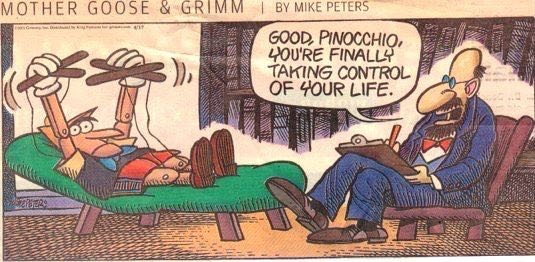
Beginning with a little humor by Brian Crane in his comic, Pickles…
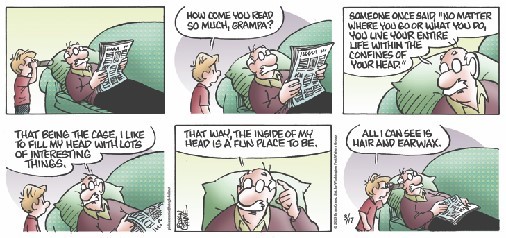
Used by permission from the copyright owner
I have been thinking thoughts about thinking……….
…..and thought I would write about some of the insights I have learned from interacting with
- thousands of clients
- students
- seminar participants
over 50 years in the role of “shrink” or coach, professor, and seminar leader.

I will also add some of the lessons I have learned living my own life, with the hope that you may create some value in the way you run your life.

My intent is to share some basis for my thinking in this relatively unconventional and unusual manner, and then add several stories of individuals who have utilized some of these ideas to create breakthrough experiences and transform their lives quickly and easily.
Sound incredible, read on.
To begin with I would like to share a comic strip, Geech, that I think is informative as well as providing an opening perspective. I share this comic to forewarn you that I am writing—aka crafting, constructing, making up, fabricating, composing, creating, formulating, etc. – these words in the way I choose to write this blog: narrative, or story, and if you were me, that’s exactly what you would write or create.
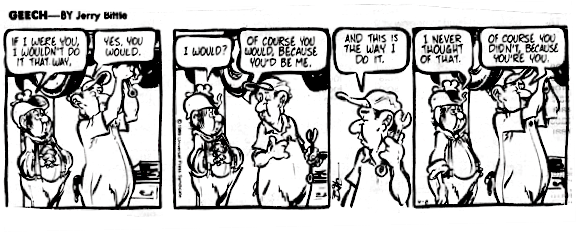
Further, If I were you, then I would be reading it the way you are reading it, with your preconceptions, perspectives, judgments, and perceptions. You will decide before long either that this approach is of interest or that it is too weird and far out—time to close the book. Either way, I respect and support your choice, because then I would be you and that is the way you do it.
The following letters (“chicken scratches” that build into words) are meaningless until you decide the meaning.
The basis of my comment is that I know what I am implying, however, I don’t know what you might be inferring (making up), since you will be deciding that. My implication and your inference may be similar or even identical (I hope), or not (even in the same ballpark?).
However, I will likely never know.
To provide you with more perspective on what I am referring to, I will share some information that I read in a newspaper.
Homeless Dave
A 57 year old homeless man in Tempe, AZ, found a back pack with $3,300 and a laptop in it and turned it over to the authorities for return to the owner.
There is more to the story which I will share shortly. But, with just this much information, I will suggest that you have probably already made a judgment, perception, or reaction about the situation.
One likely view is that since many people think this is a “dog eat dog” world where it’s “finders, keepers, losers, weepers,” they might judge that it was foolish for him to turn in the money. The justification could be that it was probably drug money and nobody would try to claim it or that the authorities would not make much of an effort to find the rightful owner. You might also think to your self, I wish that windfall had happened to me, I could sure use the money. All mine and nobody would know.
I could label this mind set as an attitude of “Grabitude.”
On the other hand there are many people who would do a different perception, judgment, or reaction about the information in the first part of the newspaper article and applaud his honesty. You might be thinking isn’t it wonderful that even a person in those dire circumstances could do the “right” thing by turning the money over to the authorities.
Same information, two different reactions or judgments based on preset perceptual patterns or biases or mind sets that we formed from our experiences as we grew up. Remember we came into this world knowing nothing and doing no judgments at all, until we made them up. More on this later.
Now I’ll add some more of the story in the paper. The man, Homeless Dave, was a recovering alcoholic, who was sleeping in a church basement and working as much as he could to pay a judgment that resulted from an accident and his third DUI. He had lost his driver’s license as well and his only transportation was a broken down bicycle. He had been sober for four years. He admitted that it was a great temptation to keep the money, but stated that it wasn’t his money, he hadn’t earned it so he couldn’t keep it and live with himself.
I wonder what he would have done if he had found a similar amount of money 5 or 6 years earlier when his major focus was getting and staying drunk. Probably he would have kept it, same situation, a very different way of looking at the world, and a very different behavior.
This story was national news in the fall of 2010 and it turned out that many people sent the man money and several invited him for Thanksgiving dinner.
The people who thought he was a fool, may have made comments to self and others, but there was no ground swell there that would have resulted in a news story. It was picked up in the local legal news and some lawyers volunteered to help him with his legal difficulties.
Bottom line—the same printed information viewed through two different “presets” or lenses or perceptive frameworks will result in two different outcomes—thinking of Homeless Dave as a sucker or a hero. It seems obvious that the person reading the article about Dave “supplies” or creates their experience or interpretation of what they are reading, not the newspaper account since the words on the paper are the same for anybody reading it. Just the reader-perceiver makes the difference— and YOU are the perceiver!
I would like to add that it is possible that some of you did not create much of a reaction to the first bit of information about the $3300, you could have looked at the finding of the money from a relatively neutral preset. However, I would guess that you might have some clear and “strong” presets if the topics were gun control, politics, same sex marriage, birth control, religion, size of government, your favorite sports team, legalizing drugs, vegan diet, animals used for drug research, education, and congress to name a few.
Some of the indicators of a non-neutral preset are loud volume when speaking (aka shouting), red faces, intensity, and derogatory terms applied to anybody that disagrees. We were not born with these presets, each of us constructed our own, and I might add that we think (that is a thought) we base these positions on “clear” evidence, facts, and logical reasoning.
Sure, you betcha, as they say in Minnesota! And we are likely to say, if you had an “open mind” and were unbiased and could listen to reason, you would have to agree with me. In my mind where I make up stuff, I would like to point to the cartoon below.
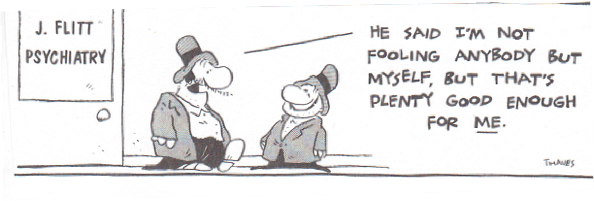
The almost universal position is that we are not fooling our selves! We make up an internal model of the world and assume that it is identical to the “world out there” and call it reality when it is only the internal reality that we make up. Everything that we have experienced is always filtered.
DO AND MAKE
You might have been surprised or curious when I underlined do and make earlier when I was writing about perception or judgment. I ask the question, who is doing your perceiving, your judging, and reacting? It turns out to be you, the person you see reflected in the mirror, you the owner! However, we do this activity so quickly and automatically that it seems to “happen” to us rather than we are actively involved in the process, thus avoiding ownership.
The “norm” in this culture is to think of having perceptions rather than actively involved in doing the perceiving. We think our reactions are the result of or caused by the written information, however, our mindset or preset world view seems to be in the role of determining factor.
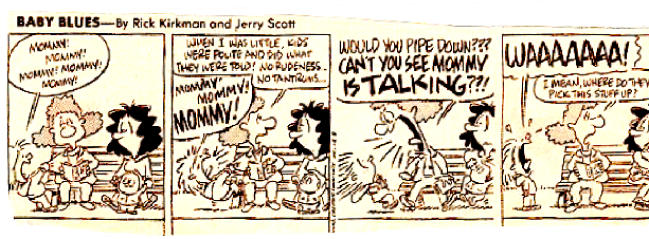
If we change our perceptions, we will change our experience. Remember we entered this world knowing nothing or no thing. As we booted up our mind, we selected a unique set or mix of presets from what was around us, that as an adult we use to make judgments about the world around us. I will illustrate with a Baby Blues comic sequence.
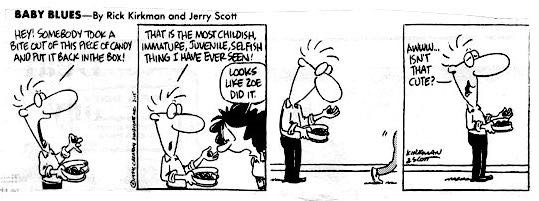
Next we have a young daughter demonstrating her preset that some yes-man had called an early morning meeting trying to worm his way up the ladder. When her mother indicates that the daughter was responsible for calling the meeting, the result is a quick switch and a different experience.
We learn some of our presets early and on our mother’s knee – as illustrated in this Sally Forth comic strip by Greg Howard.

Incidentally, we did not arrive from the womb with our perceiving patterns in place. We did not make judgments at all. We were in a buzzing, blooming world of stimuli and we began to assemble our perceptive patterns, and the language labels, from the home environment, initially.
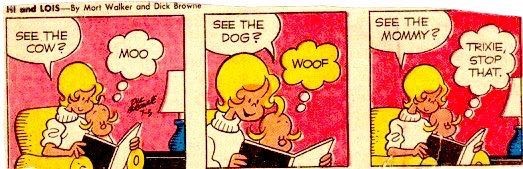
Later we began to see that our parents were not the fountains of knowledge that we had initially thought they were so we chose from the larger culture without being aware of choosing our orientations or perceptive apparatus. If we had been born in China in the nineteenth century we would likely be speaking Chinese, venerating our elders, and eating with chop sticks. The first time we saw people eating with knives and forks, we would likely think it weird and peculiar. However, most of the people reading this far were born in this country and speak English, which also includes much of the cultural norms.
The cultural norm that I will be focusing on is our assumption that we are at the effect of other people and circumstances, that we are pawns of our environment, simply because that is the way we think and talk.
Instead, I am suggesting that we provide the meaning, and hence the experience, as we look at the various stimuli in the world. A stimulus (be it a comment from somebody else or a happening in the environment) is not a “trigger” but rather an invitation to create a meaning and experience about it, based on our mind set. This may seem weird to you, similar to my eating with chop sticks when you had never seen chop sticks used before. I am suggesting that the world around you (including people) does not cause your reactions and experience, rather that you are the cause because you are in charge and no matter where you go or what you do, you live your entire life within the confines of your head (mind).
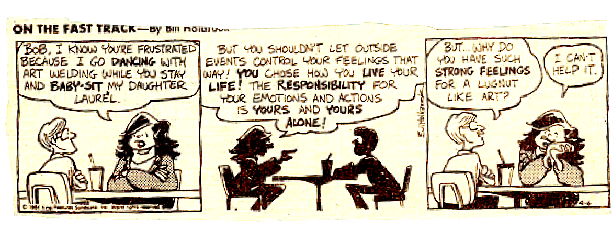
A great speech in the first two panels about responsibility for self, to Bob, followed by a negation for herself, “opting out” her ownership. She is in charge of herself, however, since she states that she can’t help it, that preset dictates her helplessness and irresponsibility for her own emotions.
MBA STUDENTS
Let me approach this as I would in a class. I had the wonderful opportunity of being involved in the role of adjunct professor with 28 sections of part time students at the School of Business at Washington University in St. Louis. Most of the students were between 25 and 40 years of age, working full time and attending night classes. They were from different companies and at different levels, some married, some not, some divorced, some with children, others not, and both genders.
The title of the course was “Interpersonal Competence in Organizations” which sounds impressive. It was one of the “touchy feely” types that was a left over from the fad of getting people to interact more effectively by being exposed to encounter groups or sensitivity training of the 50’s and 60’s.
Thus it was loosely organized and very interactive and student driven. I indicated to the students that we would not be talking about organizations and that interpersonal competence was based on intrapersonal competence, the competence within. Therefore the focus of the course was how each of us managed or operated our selves, what we “brought” with us to any situation, our presets.
The first night after those few remarks by me, I asked how many of the students were managers. Several students raised their hands and then I selected a student who had not raised his/her hand and asked what about you, you didn’t raise your hand. She/he would usually quickly say that they were not a manager yet. Then I asked that person who was managing them right now, at this moment. That seemed to be a surprising question and the student would pause as if looking internally for a boss, spouse, parent, or somebody in authority, and then would usually say something like I guess I am. I would respond with, “Bingo, 24/7!”
Next I would select somebody who had raised their hand and ask them who do you think you are managing if that other person is in charge of her/him self? Don’t you realize that each person is in charge of one person and only one, her/his self. Therefore, the other person will decide if they follow your directions, or not. My favorite way of expressing this was the following statement:
Due to circumstances beyond my control,
I have been left in charge of me.
How about you?
After a few moments of pause to let this sink in, I would then ask again how many of you are managers and all the students would raise their hands, and of course, I would also raise my hand again. I would also point out that each student chose to raise their hand, I did not “make” them raise their hand. I “invited” them, they chose.
This was clearly the beginning of a very different and unusual class in academia and many of the students seemed a little awkward and somewhat bewildered, especially since there was no syllabus handed out. On the one hand, this unorthodox course with it’s lack of emphasis on reading, research, and writing papers did not belong in an academic setting. Yet, on the other hand having some graduates who were knowledgeable about business while not being very effective in self-management did not seem to be desirable either. No one dropped the course, in fact, the classes were filled and had a waiting list because the students enjoyed the ease, informality, and typically created considerable value for themselves.
Ironically, in spite of the feedback from the students (the customers), the curriculum committee saw fit to drop it from the class offerings. I was sorry about that decision, however, I did not do upset about it. I, also, had created a great deal of enjoyment and value as well. By the time this occurred, I had already begun doing the graduate course offerings in two other places at the university for a total of 40+ additional sections.
Back to the MBA course, I spent time talking about ownership and how powerful we were inside and how powerless we were with others. Why?, because those others were in charge of themselves as well. We have no leverage with others. Of course I’m referring to the psychological domain where we cannot help or hurt someone else, although the cultural story is that we can. This is in contrast with the physical and financial area where we can help or hurt someone else. For example, we can assist someone to move something or we can hurt them by hitting them. Financially, we can lend someone money or we can steal from them. I’m suggesting that the psychological area is very different. The cultural norm or preset seems to be that we can help or hurt the feelings of others, or we can be hurt or helped, even though nobody else can get into your mind or my mind. This may sound weird to you and if it does, you are doing a preset judgment based on the “usual way of fooling your self.”
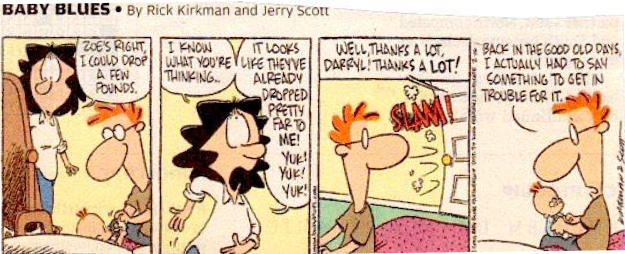
The comic above illustrates how the wife “choses anger” and attributes that to her husband even though he didn’t say a word. She is operating from the conviction (or that the way she is fooling her self) that she can read his mind, not being aware that her thoughts are only a guess.
TEACHING
In regard to this view, there are some consequences when everybody is operating from a position of ownership. For example, I would tell the students that I could not teach them anything since each of them was in charge of what they learned. Now this is a strange statement from someone playing the role of professor at that moment. I would continue by saying that nobody has ever taught me anything, nor has anybody ever taught you anything. Again this may seem strange to you since if you are statistically “normal” in this culture, you will think, and say, that your teachers have taught you a great deal. That way of thinking and phrasing makes it seem as if the teacher is powerful and the student is an empty vessel where the teacher pours in knowledge-known as the “mug and jug” approach. I propose that the teacher is powerful within and that the student is also powerful within. The teacher’s role is to set up a cafeteria line of ideas and information and it is the student’s role to select and sample for what is useful and valuable. Keep what serves them and ignore or discard what doesn’t fit their interest, that is called learning. This is similar to buying and selling. Selling is offering and the buyer decides to make the deal or not. If there is nobody offering items for sale, there is no buyer. Also, if there are no buyers, the potential seller will not make a sale. Getting back to the classroom, I would say that I have some thoughts and ideas to place on the cafeteria line that you may find useful and it’s up to you to determine if they have value for you. Pick out what you want and experiment to see if they are useful for you, never mind if they are useful for anybody else. That is your end of the deal since I know I can’t teach you anything. I would recommend that you don’t sit there passively, waiting for me to teach you something. I confess my impotency with you because we are dealing with the psychological arena, not the physical or financial.
I would also recommend that you change your pronouns to reflect ownership. Instead of saying, and thinking, “she taught me a great deal,”
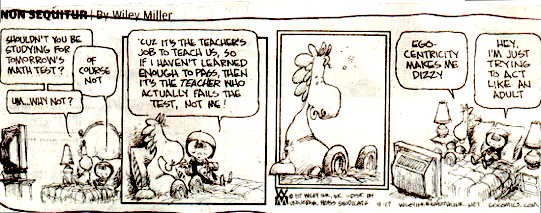
I would suggest, “I learned a lot when I was in her class.”
I see that as a very important distinction and the passive phrasing is far too common in our culture.
CONVINCING
As soon as I mention the next topic, you can probably anticipate my view. The focus is on convincing and I think nobody has ever convinced you of anything, nor has anybody ever convinced me of anything. The way I look at it is that I may use some of the data I got from you and convince myself, you don’t get to vote since I have the only vote that counts. Since you have been left in charge of you, your vote is the only one that counts for you.
When we phrase our experience passively, as in he convinced me, where is our ownership? What happened to our “power?” Nonexistent! In terms of the passive sentence structure, he, the other person, is the subject or doer and me is the direct object, the doee. If somebody else can convince you, then you have no choice or response ability.
MOTIVATION
On to the next topic, motivation. People go to hear motivational speakers to “get motivated.” However, the speakers are like teachers, similarly impotent to do the job. I suggest that the only motivation that counts is the one you decide inside. The speaker, boss, parent, or teacher can invite you to demonstrate motivated behavior using money, threats, praise, etc., however, it is your choice to respond, or not. Some people leave the motivational seminar or the bosses’ office and use their motivation to grouse about what was said and the waste of time. Others, leave excited (having excited them selves) thinking about how they can utilize the information they just heard. Same talk, different reactions, just like the newspaper article about the homeless man. Thus, I am consistent and tell the students that I am incapable of motivating them so don’t sit there passively, waiting for me to “change or charge” them.
INFLUENCING
The last item that is consistent with the three previous topics has to do with influence. Think about it, if I had the ability to influence the class members, I certainly would do it, and I would do it quickly, no long series of classes.
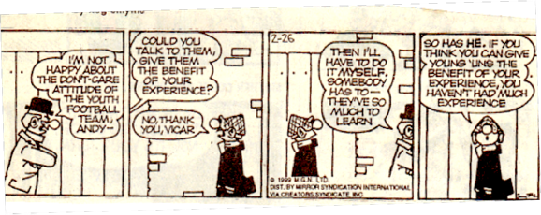
However, I think each class member will decide how much influence I have with them and it is likely to range from a little bit to a lot, not at all sensitive to my vote. However our cultural norm is full of stories about she was a good influence on me or he was influenced by the wrong crowd. Or, society makes me act this way. Once again, where is the owner? The way we think about and phrase our views suggests that people are moldable globs of protoplasm at the effect of society. Incidentally, I have never met society, I’ve only met individuals, but once again the cultural norm is to use our power to pretend that some abstract concept (society) is in charge of us. (Also, incidentally, I think we are moldable globs of protoplasm—but only from within, by the owner!) I would like to add a perspective about experience, which is different from knowledge. Knowledge can be exchanged or transferred while experience cannot. Experience is what you make up about what you think is going on “out there” within you and can be described but not exchanged. Think about chocolate ice cream and you can describe the taste, texture, temperature, etc., however, you cannot transfer the experience. The novice has to actually partake to gain their own experience.
INVITING
After sharing my inability to teach, convince, motivate, or influence these students, what am I left with? Answer: I can only invite responsible (response able) and capable individuals to consider the benefits of experimenting with some different ways of thinking. I can begin to set some items on the cafeteria line and invite them to pick up a tray and explore some different ways of thinking. I would also promise to share some stories about how some students, seminar participants, and clients had created value for themselves easily and quickly.
FREEDOM
At the end of the first class session I would relate a story about a young man who approached a guru and asked something like, great sage, what is the way to liberation and freedom. The elder then asked the youth if he would mind showing him his chains. Whereupon the youth became perplexed, looked at his arms and legs, and responded that he did not have any chains. Then the old man asked why would you seek liberation and freedom when you are already unchained? A very interesting question. I then suggested that the students use the freedom that they are already “stuck with” to experiment with using their freedom in a way that serves them better. I also indicated that at the beginning of the each class I would ask for anybody who was willing to share their breakthrough experience, also known as using their freedom to operate themselves in a more constructive manner.
IMPLEMENTATION
Bill, Jr.
I can share an example of a response to my question in the next class session. Bill raised his hand and animatedly told a story of his interaction with his father that took place over the phone. His father, Bill, Sr., had a pattern of telling his son Bill, Jr. what he should do. Bill, Jr. had a well established pattern of choosing (outside of awareness) upset and anger as his response, (while attributing the power to do this to his father). The father was assisting his son by paying half of his tuition so he felt entitled to express his views. When his father called the previous night they began in the familiar pattern with his father telling and the son beginning to do his usual anger pattern. All of a sudden Bill, Jr. flashed back to the class and shifted into the position that he was in charge of himself and his father could not “drive him up the wall” as usual. Instead he listened from an internal position of comfort and even thanked his father for some of his comments.
Bill, Jr. was very aware of using his freedom differently and felt great.
Shortly thereafter his wife who had been in the other room came in and asked him who he had been talking to. When he said it was his dad, she was incredulous because it was such a sudden change. When he related this in the class he added that he felt fantastic knowing that he could change so quickly and that he looked forward to more exchanges with his father in order to practice his breakthrough. He said it was a relief to realize that his father did not need to change first before he could feel comfortable. Quite a change from dreading his father’s calls.
Ruth Nails
About 2 weeks into the class meetings, Ruth, probably in her mid 20’s held up her hands in display and proudly announced, “I have fingernails!” She then related how she had bitten her fingernails all her life. Even as a child her parents had tried all sorts of methods to help her stop this pattern, putting vile tasting substances on her fingers, making her wear gloves at night, etc., to no avail. As an adult she was acutely aware and ashamed that she could not stop this behavior where the evidence was easily visible to the world. Even though she did not bite her nails in front of others, she still felt that since the results were so obvious that “everybody knew.” She related all this with considerable excitement and enthusiasm, adding that she was a little baffled about the ease of change.
Of course one of the class members asked what did she do to stop. Her answer seemed surprising to many of the other students because her answer was NOTHING. She went on to explain that when she realized she was in charge of herself and that she was the one who was doing the biting of her nails, all she had to do was nothing, or no thing since she was free to do herself any way she wanted. She said she realized that she had always stopped, especially when she drew blood, so the issue was staying stopped, i.e., not biting, and to do that was to do nothing (no thing) about her nails and, lo and behold, in a couple of weeks or so, there were her nails.
Simple, quick, and easy to change a pattern of long standing— because being aware of being in charge is vastly different than being at the effect of a “bad habit” or a “compulsion.” (This is similar to the previous student who had played the role of being at the effect of his father’s comments and felt that his dad had to change first.) Ruth added that she felt a little foolish in retrospect since the solution was so simple and easy, however, her main feeling was proud and triumphant. She knew that she was done with her pattern of biting her nails! At the next class she held up her hands once again proudly announcing that she had had her first manicure. I might add that this may not seem like such a big deal to a man, however, it is more likely of interest to a woman.
EASY CHANGE??
You may be doing a little bewilderment or skepticism about the ease and simplicity of the change by the two students who changed so quickly, and with no effort I might add. Part of the explanation is that when I talked about change with the students, I used the word, pattern, rather than habit. The difference is just semantics, right? However, even though they are similar in some ways, there is a major difference. In our cultural “story” or preset about changing a habit typically involves effort, difficulty, and a lengthy period of time, besides being unenjoyable. You see, the word habit comes with the “baggage” of strength and morality. Habits are either weak or strong and good or bad. In the student’s mind, she had a “bad” habit that she had to work hard on “overcoming” since “it” was very “strong” and had lasted many years. It’s as if the habit is in control. In contrast a pattern does not seem to have strength or morality linked to it, thus, easier to change. More skepticism??
You may think that this emphasis is so trivial that it is not even worth mentioning. I would like to refer back to the story about the homeless man finding all that money, when with very little information you probably already made a judgment about sucker or hero. In other words, you probably have internalized the cultural story about habits so you would in all likelihood have automatically dismissed my distinction as unimportant. I understand and if I were you, I would have done the same.
TIME FOR A LITTLE HUMOR
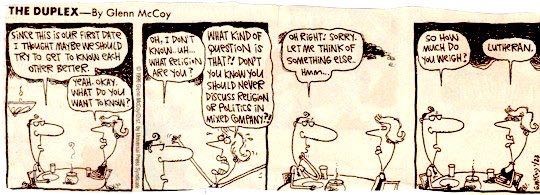
I haven’t entered a comic for some time so I want to invite you to lighten up since I don’t want you to take me seriously, just lightly and playfully. I will add a comic just for chuckles from time to time. Weird, I know.
DRIVER OR BACK SEAT PASSENGER
Even more central to ease and simplicity is the issue of who is driving your vehicle or unit. Although you have never done this, except perhaps verbally, I would like you to imagine driving your car while you are in the back seat.
Ridiculous, right? Yes, it would be extremely difficult, if not impossible. Contrast that thought with how you do your driving while in the driver’s seat. You are at the wheel and there is no difficulty involved with changing lanes and directions, even a u turn, or in the case of the Bill, Jr. and Ruth, “I turns.” If you think of your self as being in the “pawn” position where other people or events are “steering” you and “making you feel” one way of another, then you are in the back seat and changing your behavior or feelings becomes difficult or impossible.
Bill, Jr. had clearly been operating himself in the illusion of no choice since it was his father (in the driver’s seat) that was upsetting him and he spent his time yelling at his father to get off his back i.e., quit telling him what to do. (Of course he was also telling his father what not to do.) When he clicked into the alternative illusion of having been left in charge of himself, he made an “I turn” and began operating himself more constructively quickly and easily—to his wife’s surprise. Incidentally, his father did not have to change first!
Many people spend a lot of time waiting for the other person to change their behavior first so that they can feel better. Why wait? Why not take better care of your self immediately? That would be a great example of using one’s freedom in a way that serves one better, as well as a clear example of more effective intra-personal competence which becomes the basis of better interpersonal competence.
Ruth Nails apparently thought her “compulsion” or “habit” of biting her nails was in the driver’s seat and she was along for the ride, unable to reach the steering wheel. When she used her freedom (that she already had, but not aware of) to begin operating her self with the wheel in her control, she “disappeared” the issue at once. She stated that for the first few days she realized that she had moved her hand to her mouth fairly often, a decision made outside of awareness, but becoming aware, she would simply smile and lower her hand, no longer “compelled” to continue to bite her nails.
Ease and simplicity of change is certainly not the norm in this puritanical derived culture, it may even seem like an illusion. Actually, I would say that it is an illusion, a very useful illusion compared to the usual illusion of somebody or something causing my feelings, with me trying to drive from the back seat which results in great difficulty of changing.
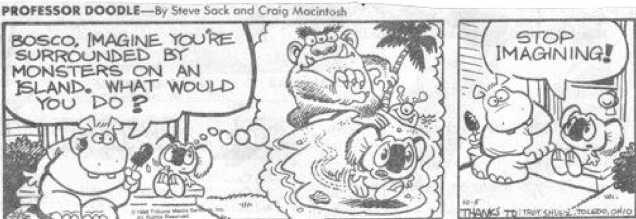
(Addendum to comic: Think or imagine something else)
If you are in charge of your imagination (thoughts), it is very simple to think of something else, virtually anything else, and thinking of something else results in a different feeling. Contrast this with making up, and experiencing, the following: I can’t stop thinking about my ex and how she/ he fooled me so badly. Or, it makes me so mad to think of how I was duped, I can’t help dwelling on it. Sentences of your impotence that you will serve until you change your mind.
I can hear the comments about how I make it sound so easy and it’s hard to put it out of my mind. I will expand on this later.
Earlier I used the words puritanical derived culture and I would like to go back to our early history. There were many nationalities represented early on the East coast: Spain, Italy, Germany, England, France, as well as Scandinavia. Of all this mix our constitution was written in English and the question is why English? The most likely explanation is that the Puritans from England emphasized education and founded a number of schools and universities.
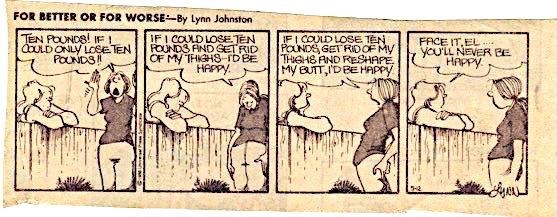
As I read about the Puritans they were not a happy go lucky bunch, rather severe and judgmental. They were interested in feeling good, just like us, however, it seemed that feeling good was postponed for a long time, like heaven. We are “downstream” from the Puritans and we still tend to postpone feeling good until we get a degree, a job, a marriage, children, lose weight, etc. Happiness is just around the corner or down the road but not NOW. Also we emphasize judgment of good and bad, right and wrong, about our selves and others. I would agree that judgment is important, however, what about judging for utility or usefulness?
Bottom line: Back to—due to circumstances beyond my control, I have been left in charge of me, what are the circumstances beyond my control?
Answer, I grew up and became an adult. However, I started out as an infant, just like you, totally helpless and not responsible for anything. I (and you) was not responsible financially, legally, religiously, behaviorally, or emotionally—just a bundle of reflexes. I had no mind, just the potential for mind, incapable of caring for my self. As I just said, the circumstances beyond my control is that I grew up, developed a mind of my own, that I own. Over the years as a youngster and teenager I gradually took over the administration of my “unit” and learned a degree of responsibility, as well as response ability, my ability to respond differently to the same invitation or stimulus.
I went from a “me” to “I” in many areas. Remember how toddlers were likely to say, “me want” instead of “I want. For example, I had role models and learned to say, I bought these shoes, not the store made me buy these shoes, an example of financial responsibility. In the legal area I said I voted for so and so, not my wife made me vote for him or her. In the religious area I was responsible, in my case after being trained in Sunday school and religious instruction. At confirmation, I was told that I was responsible for my church attendance, no longer my parents. I learned I was also responsible for my physical behavior, saying I brush my teeth, not my dentist makes me brush my teeth.
Unfortunately, there was no training or role models for emotional responsibility. Actually, there were negative role models, or models of irresponsibility making statements like, you kids are driving me up the wall, a clear example that the parent thinks the children are at the wheel.
On the positive side, a parent might say you make me proud when you bring home a good report card. Again the parent is a me, in the back seat, not an I in the driver’s seat, bereft of choice. Why is this important? Let’s go back to 5th grade and look at sentence construction as in the boy hit the ball. The boy is the subject, the active agent, the doer. Hit is the verb that describes the action. The ball is the direct object or object of the verb, the recipient of the action, the doee.
What is critical is the fact that the ball has no choice regarding where and when it is hit, the boy is in the driver’s seat. Similarly, when the parent (or any other adult) states that the child is “making” them feel one way or another, the parent has inadvertently as well as linguistically placed the child in the driver’s seat and taken a back seat or ball position. This was so clearly demonstrated with the 30 year old student, Bill,Jr., at the effect of his father’s comments, and I would suspect that the father had inadvertently played the same role, thinking that his son’s yelling and obstinacy “made” him feel bad.
With that kind of “victimology” mind set, it seems as if person A’s feeling are determined by person B and B’s feeling dependent on what A says and does. And if each person does not have the responsibility for their own feelings, then how can each feel better if the other person is unwilling to change their behavior? Gridlock!
If either one understands their psychological omnipotence for self (since they are stuck with the wheel in their own hands) and their impotence regarding the other, that person can shift their feelings independent of the other person, as demonstrated by Bill,Jr. who changed before his dad changed. Another way of making this point is to think about leverage, the ability to cause movement. The cultural “story” seems to place the leverage of change in other people’s hands, other people teach, convince, motivate and influence us as if we are puppets and they are the puppeteers. This ignores what we are “stuck” with, being at the wheel, where changing direction and speed is simple and easy, especially with our “power” steering!
Before going on to another example of rapid change, I would again like to indicate that I am focused on emotional behavior. I want to reiterate what I covered earlier: I think of three different domains as physical, financial, and emotional, the first two are very different from the third in terms of effect. In the physical area we can help and hurt somebody else. In the financial area we can help by lending some money or we can hurt by stealing some money from them. The psychological area is different, since each person is totally responsible for themselves—and their perceptions or interpretations! Our mind is our own and we own it, a sort of sealed system. The stimulus outside does not trigger, it is simply an invitation for a person to choose a reaction— from many possible reactions.
THREE UMPIRES
Perhaps a story about three baseball umpires may illustrate the point. The 3 were discussing their work.
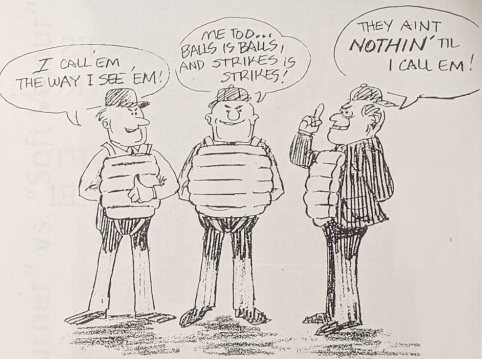
- The first ump said that he calls them the way he sees them.
- The second ump states me, too, if they are balls, I call them balls and if they are strikes, I call them strikes.
- The third ump then says they ain’t nothing until I call them.
We are each our own umpire, making all the calls for ourselves, underlining how powerful we are, although only for our self! At a ballgame with 40 thousand fans (aka umpires no matter how far away) the “perception” of the home team pitcher’s pitches is that the majority are strikes. The perception of the opposing pitcher is likely to be that he is throwing mostly balls and that the umpire is blind.
At the beginning of my THOUGHTS, I asked you to make a “call” about whether Homeless Dave was a sucker or a hero—with very little information! When you read about the rapid and easy change the two students, Bill, Jr., and Ruth Nails made, you provided the call whether it was one of surprise, doubt that it could be that easy, even impossible, interesting, or any other reaction. Your reaction was not dictated by the words you read! The meaning or reaction you applied or supplied to them is your own. You are “stuck” in the driver’s seat, in the umpire role, whether you are aware or not, or whether you like it or not.
I have a drawing of a person at the wheel on the deck of a sailboat, dressed in a slicker and a hat so that it is impossible to determine the gender since we are looking at the person from behind. Attached to one leg is a leg iron hooked up to a chain that leads to a bolt in the deck. The message is clear, the person can not leave the wheel! We are not in charge of the wind or the waves (external circumstances), however, we are in charge of the rudder, i.e., how we steer, how we react to the wind and waves.
Since I think that cartoonists have a knack for “capturing” what I am trying to explain, I will turn to a Hagar the Horrible sequence. Hagar is a Viking and the first frame has him approaching his home with a big bag on his back.
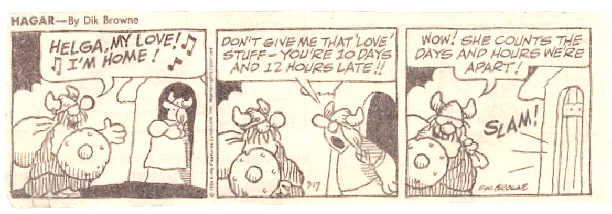
Apparently Hagar has completed a successful raid. He yells, “Helga, my love, I’m home.” The next frame shows Helga with her hands on her hips and angrily yelling, “Don’t give me that love stuff, you’re 10 days and 4 hours late.” In the third frame, Helga has slammed the door in his face and Hagar is standing outside with a big smile on his face saying, “Wow, she counts the days and hours I’m away.”
The norm in our culture is to do anger or hurt in a situation like that. The likely behaviors in the former would be to knock down the door and beat the wife. In the case of hurt feelings—go to the tavern and commiserate with the bartender. Hagar is the umpire and he has made an unusual “call” that not only benefits him immediately but also avoids berating his wife, the secondary beneficiary. He does not need anybody else’s permission nor can anybody stop him since nobody else can influence him.
MORE IMPLEMENTATION
Burt McTemper
A middle aged client, Burt McTemper, presented several issues that he wanted help with. I indicated that I could not help him and he seemed surprised since the friend who referred him to me had said that I had helped him a great deal. Of course, being in the psychological domain, I am unable to help or hurt, I can only invite or “coach,” i.e., offer hints, tips, or suggestions that he might experiment with to see if any are useful to him. To me it seems important to convey my impotence over anybody else from the beginning, just as I did in my classes.
Burt had hired me as a consultant, not as someone who was going to “fix” his problems. Although I didn’t say this to him, my view of him was that he was in charge of himself, and further, that if he used his control more constructively, he could fix or disappear his own problems.
He introduced one of his issues by saying that his temper had gotten him into a lot of trouble. I asked what kind of trouble and he listed fighting, a broken jaw, getting arrested, two divorces, getting fired, and his kids wouldn’t talk to him. I agreed that this was a lot of problems and then I added that I would suggest not doing bad temper anymore. He looked a little incredulous and added that he couldn’t help it, that he lost control when “somebody set him off”. (Clearly somebody else was the driver.) I indicated that I didn’t think he lost his control, rather that he used his control to make his voice louder and his face red. I also said that he was probably talking English because if he did not have any control he wouldn’t be able to talk any language. I also asked if he ever hit anybody and when he answered affirmatively, I said that takes a lot of coordination which is another word for control.
His next alibi for not being able to control his temper was that his dad had a bad temper also. I suggested that he and his dad were two different people and although his dad was a role model, my client certainly didn’t imitate his father in every way, he chose what to imitate, although not in awareness.
His next reason for “his lack of control” was that he had always had a bad temper, it was the way he was and so far he had not had very good luck controlling himself if somebody “sets him off.” That phrase indicates that other people were seen as the trigger of his behavior. He added that he knew he shouldn’t, that he considered himself a good Catholic and that he had tried hard and didn’t know what else to try, which I interpreted as being open to suggestions.
I told him that I had an idea that might be useful but that it was sort of silly. He looked expectant and I said I needed a little more data first. I asked him when was the last time he blew up at somebody. His response was about a week ago. Then I asked him if he could remember what the guy looked like and he went back in his memory or archives and said he could see the other person and that he was red in the face and yelling. He went on to say that he was doing the same thing, but they didn’t get into a physical fight, just verbal.
Next I went back to his statement that he had always had a bad temper and I indicated that he had only done bad temper from time to time up to now, that he hadn’t done bad temper tomorrow. He said of course not, it’s not tomorrow yet. I then asked him to imagine that he didn’t do bad temper for a week, then added how about a month. Then, let’s go big, how about a whole year? I then asked if he didn’t do bad temper for a whole year, could anybody, including himself, say that he had a bad temper? His answer was I guess not. I then added that this would be the case and that you have to do bad temper in order to experience bad temper.
You notice that I inserted “do” and “doing” in my conversation. Why?
Because if you’re doing something, you can stop doing that something, whereas if you “have” bad temper like a mole or a birthmark, you are stuck with it. This is similar to the thinking that was characteristic of Ruth, the student and her nails. She had a bad habit. When she experimented with the idea that she was in charge and she was “doing” the behavior, she realized that she could simply not do it. You may notice that I was talking to my client in a way that assumed that he was in charge of himself—that he was at the wheel, that he was doing the driving.
My next move was to ask him to recall the scene of his recent blow up, which he did. Okay, you are back in the middle of that and you can feel your self starting to do anger. My question is what would you have done if your priest had appeared in the middle of your spat. He responded that he would have stopped, of course. I then asked him how he could have stopped if he didn’t have control? He looked confused, especially when I handed him a cartoon to look at.
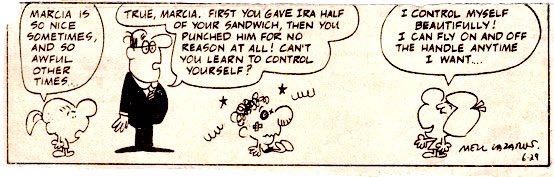
This is an old Miss Peach comic focused on Ira and Marcia, two young children in kindergarten. The principal asks the “normal” question can’t you learn to control yourself as if she isn’t in control. Her response is surprising since she is aware that it is her choice.
I asked Mr. McTemper what he thought of the cartoon and he responded with you got me. I said I didn’t get you, you recognized that you are like Marcia that you pick your spots whenever you want.
For example, you said you would not do bad temper in front of your priest. I also suspect that if you were insulted by a member of a group of Hells Angels you would not bring up and demonstrate your bad temper. He admitted that would be the case.
I then said here is my silly idea. I am pretty sure that it takes a second or two for you to get to full flare. During that instant you can picture your priest, like you just did here earlier, or you can think of the Marcia comic. Actually, you can think about a lot of things, me, Monarch butterflies, Australian aborigines, in fact anything else. The idea is to flash over to a different scene or channel which is a way you can interrupt your buildup. It appeared to me that he was doing a dry run in his head which seemed to be confirmed when he stated, you know that might work.
At this point I mentioned that he had a pattern or preset of “looking for” people who disagreed with him or acted in a way he did not want them to and then he would choose to begin doing anger with no awareness that it was his choice. He still would probably be on the alert in this regard, and the good news is that he would have a chance to start to flare and interrupt, in other words, a chance to practice. So the world out there was not going to be different, that was not under his control. What was different is that he now had the opportunity to do himself differently than “he always had” in similar circumstances. Be prepared to feel a little weird because it’s a little like learning a new dance step, not that it’s difficult, it just feels awkward.
At the beginning of the next session I asked how he did himself during the interval. Burt’s response was that he did feel weird and awkward but that he was pleased that he now had the ability to do himself differently (of course, he always had the ability, however not in his awareness). I asked him if he had a lot of practice and he said yes and that he was feeling less weird as time went on. I then observed that this was a rather momentous shift that he had made and he agreed. I asked if he was surprised at how fast and easily he could make the shift and again he agreed.
I thought I would have a little fun and said that since this was such a big step that he had taken so quickly, that maybe it was too quick and he should go back to his old behavior for awhile. He looked a little aghast and basically said no way. I then added it seems like it doesn’t make any difference what I say, it’s only what you say about what I say. He agreed and I added it seems like it’s always that way.
AUTO PILOT
Before I go any further, I want to focus on our decision making, especially what we decide outside of awareness similar to a decision making that “seems” to be robotic. As we left infancy and toddler hood, we began taking over the “administration” of our unit. We started from total helplessness and began a 180 degree journey of change toward adulthood and responsibility. We began dressing ourselves and developed patterns (not habits) that we follow throughout our lives. For example, by the time we have arrived at the age of double digits, we have well practiced patterns of which leg goes in the slacks first, how we hold our eating utensils, which way we fold our hands and arms, etc.
Now as an adult, 20, 40, or 60 years later, take a moment to “see” which leg goes in your slacks first. Usually most people will immediately say left or right. Next, when I ask them to imagine putting the other leg in first, they say that they would have to lean against something or they might say that they would fall over. In other words, they have been putting the same leg in first for years and doing the opposite is very awkward, some would even say difficult or hard. Actually, it would take the same amount of energy so it would not be hard, just awkward.
They have been free to put the other leg in first for years, but they never did, hence the awkwardness, which is testimony to the accuracy of their decision making regarding which leg is first, outside of awareness. If they had made a 5% error rate over the years, they would not think it awkward. I prefer that term, outside of awareness, instead of what most people would use, unconscious, which I think of as out of commission.
The person is in control, just deciding in auto pilot and what is very important is that the pilot can get out of auto pilot and make decisions in awareness, clearly ownership, as demonstrated by the previous three implementations. A short example of robotic behavior—in an electric failure at night, we still flip the switch when we enter another dark room.
Back to that feeling of awkwardness when simulating (in your mind) inserting the other leg first, most people would say it is almost a loss of equilibrium or balance. This is the result of a simulation, not an actual outward behavior. You never moved a muscle yet created the feeling of loss of balance. What this suggests is that we are very robotic in much of our physical behavior and very sensitive to not doing any variation. I suggest that this adherence to our early patterns also applies to our emotional decisions and accounts for the type of language such as, “You upset me,” and “You make me laugh.”
Next I ask, what if we had developed a program in our mind that basically could be described as avoid the awkwardness that would result from changing any emotional patterns? What would that mean if we avoided awkwardness? We would never change, we would never cross the threshold to a new way of thinking and behaving. Remember that I alerted Burt to the accompaniment of change, that he was likely to feel a little weird. Having heard this he was less likely to stop his move into a more useful pattern.
I might add that I alerted you in the beginning that I was making up everything that I am writing. Of course this is the case since this sentence wasn’t there before I made it up. Likewise when I talk, I make up the sentences (ad-libbing) and then others make up what I said.
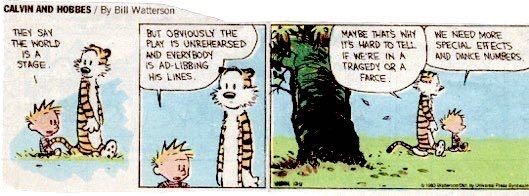
Incidentally, I like what Calvin was ad-libbing about special effects and dance numbers. Bill Watterson points out a philosophy of life that I subscribe to and recommend to you, the reader.
This parallels movies where the audience is exposed to the same light and sound, yet there are frequently major differences in how the light and sound are experienced by different individuals. Each person is “right” in their own mind—there are different versions because of the variety of mind sets or predispositions as well as different life experiences, different genders, different ages, etc.
So far, I have given three examples of implementation and more to come, however, I have “lost” all the readers who have focused on the unconventional ideas and missed the value. Similarly in my private practice clients would self select since no one size fits all. Those that created value continued and those that didn’t, never showed up again. Once again I support either decision, because it I were them, that’s what I would do.
Before going on to another example, I would like to add another cultural story about feelings. We seem to have the mental capacity to “split off” a conceptual portion of ourselves and make it powerful or at the wheel. Think about how the previous client, Burt McTemper, thought about his temper. It seemed a separate part that “took over” and he was in the back seat. He could easily make a significant change when he realized that he was doing the bad temper. He came in with my temper has gotten me in a lot of trouble, clearly a me, not an I. He followed with an I sentence as in I can’t help it. In that powerful sentence with an I, he seemed to make himself powerless. This is common as in, I couldn’t stop myself from eating the whole pizza, I was helpless, I didn’t know what I was doing, I lost it, to give a few examples.
This is also the case for jealousy as well, my jealousy made me do it.
SENTENCING
Using those sentences of powerlessness is a way of creating the feeling of powerlessness. Let me explain what I mean. In the first panel of the comic below, the young man makes up a sentence about the present and future. It turns out to be a “life sentence” since being alone is lonely and being with Lisa is crowded. As long as he thinks like this, he will feel lonely or crowded.
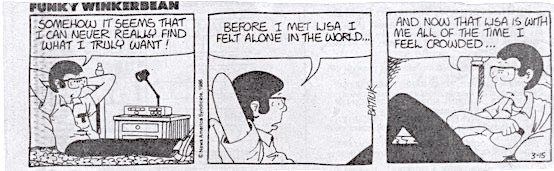
For a moment I want to step aside and invite you to imagine being in a court room where the judge is sentencing a person found guilty, to 10 years in prison. The judge uses a linguistic sentence to mete out a judicial sentence AND the prisoner has to serve the sentence. Now go back to sentence and see what the young man in the comic has sentenced himself to—never finding what he really wants. He is simply serving his own “life” sentence when neither being alone or with Lisa is any good.
What is of more interest, since he was the “judge” that sentenced him, he is also the judge that can commute the sentence. How would that go? He could say he enjoys being alone because he values his privacy and he also enjoys being with Liza. Serving this sentence will facilitate a different experience. You can also see how those powerful “I” statements of powerlessness led to a seemingly impotent experience.
We saw that previously in an earlier comic, “I can’t help it.”
Before I continue on the topic of sentencing and the importance of how we “language” our experience, I want to share some personal background.
I was brought up in a fundamental religious background with a heavy emphasis on sin, guilt, and the threat of Hell. Because I did not know alternatives, I thought of myself as being born in original sin and going downhill from there, which didn’t facilitate the development of positive self esteem. Because of this dis-ease, when I was in graduate school, I sought out a therapist for “help.” Since Sigmund Freud’s theories were the most common thought at the university, I ended up with a psychoanalyst in analysis for about 3 years. He had studied with Freud, smoked a cigar in the session, and seemed primarily interested in my childhood and any dreams I might have. Of course, I did the usual blaming of my parents, attributing the cause of my problems to them, and my therapist never pointed out that was then (history), you are now in now, free to do my self differently.
We sorted through yesterday’s broccoli looking for clues to my difficulties and analyzed my dreams. The emphasis was on the past, not what I could do now and in the future. I was encouraged to do “free association” which turned out to be expensive over the amount of time I put myself through this effort. I finally quit against his advice since I did not seem to be making much progress even though I “knew” that change would take a long time.
He never said that he could help me, however, that seemed implicit when he was the knowledgeable doctor and I was but a patient—although I turned impatient. I want to add that he never told me that he couldn’t help me, which might have been helpful since I might have begun to look for wisdom within rather than waiting for his wisdom to fix me.
As I look back I think he was as sincere as I have been in my practice, so I disappeared any resentment that I created when I quit. Also, I figured out, or relabeled, that it was a great experience of my learning what not to do. Whenever I asked any question about him, he always turned it back to me saying this is about you, not me. He talked very little and I do not remember any humor. I laid on the couch and he sat at a desk where I could not see him, apparently providing the “blank screen” for my ramblings. I remember crying about some of my childhood memories and I hoped that he could see that I had suffered enough and that he would get out a stamp and stamp my forehead with a big OK. Of course that was unrealistic but the peculiar part was when I realized that even if he had, it would not be enough.
From what I have shared about my interactions with my clients, NOT PATIENTS, you can see that I approach this process very differently. I use comics and encourage humor since a person can’t get out of a hole by digging it deeper anymore than a serious/grim person can get out of seriousness by getting more serious. So although the client and I talk about topics considered serious, we don’t have to do grim while discussing. I have come to the conclusion that if our interaction isn’t enjoyable, not much is being accomplished. Most clients come in pretty serious and wanting to feel better so I don’t see where a focus on the past and a lot of “gut grinding” is relevant to creating a present that leads to a better future.
Think about this. If a person enjoys counseling sessions, he/she is well on their way to their goal—which is to feel better. I very much enjoy interacting with my client’s so I’m not watching the clock and I do delight when the client does an aha experience. And I want to add, I am clear that I did not “help” the client, she/he took some of my suggestions and created value by experimenting with changing their mind and behavior. I view my “coaching” sessions as the client and I getting together and “ad-libbing” about different ways of thinking.
A last word about the Freudian approach where the mind is divided up into different categories that he “animated” like id, ego, and superego, the latter being somewhat equivalent to our conscience and the id being like our primal, uncontrollable raw nature. Another word that he introduced, or at least made popular, was an unconscious that was very powerful and clearly difficult for an individual to control. The difficulty I see in this categorization is that they become alibis for irresponsible behavior. Just as temper and jealousy were separated out and blamed for explosive behavior, the unconscious occupies much the same kind of niche. Remember statements that were used to split off and make powerful sentences like my temper took control, the statement that it must have been my unconscious also is an alibi that “seems” to absolve the person for the responsibility for their behavior.
Again it seems like a case where a person sentences her/him self to a pawn position by ceding the power to a powerful construct that does the controlling. Back to the back seat.
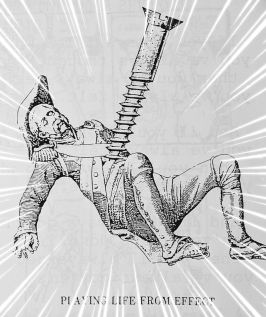
Although this may seem simplistic I tend to think of the mind’s operation differently than most. Many people sentence themselves as being at the effect of the mind in statements like, my mind is driving me crazy, or my mind has a mind of it’s own, denying ownership. Just as we have a hand that is a useful tool in scratching or turning a page, I think of my mind as a tool for thinking thoughts, AND I can change my thoughts.
I recall a speaker that made a sentence that I will never forget: my mind is my favorite toy! That statement certainly suggests ownership as well as playfulness. I also like a statement that is very different but captures another aspect of our minds, this time from a Buddhist elder:
“The mind is like a drunken monkey staggering from one thought to another. People who do meditation certainly encounter this when they attempt to “still” or “empty” their mind.”
The way I think about the mind is somewhat analogous to a TV set. There is the channel that I am watching, i.e., I am aware and it could be called focal attention, almost as if there is nothing else. Then there are all those other channels that are available if I choose or select, however, they are outside of awareness until I do. Additionally, and importantly, the remote is in my hand!

If you have read this far, you have been making up your interpretation and experience of what I have written. If you are sitting down, you are probably not aware of the pressure on your backside resulting from gravitational pull.
Notice how you changed channels for a moment. We can direct our minds to some extent but it will never be still. Thinking back to Burt McTemper who had created the issue with his temper by thinking of it being powerful and uncontrollable. I invited him to change channels (i.e., interrupt his usual pattern of anger). And when he did, he created sufficient benefit that he basically disappeared the problem he formerly had been appearing. He made an I turn and I did not have to explain anything about the use of his mind. Because he created value from changing channels, when I suggested that he go back to his previous pattern, he rejected my comment.
ANOTHER IMPLEMENTATION
Ralph Holder
Ralph Holder was about 40, married with three children, one a 10 year old boy. He described himself as a workaholic and felt he was loosing touch with his family and felt that he wanted to do himself differently. I shared some of the ideas about being stuck in control, my not being able to help him, being free since he did not have any chains, etc.
The third session was different from the beginning, he came in glowing, obviously eager to share. The family had a membership in a health club and on Saturday he had asked his son to go along while he worked out. The boy wanted to go swimming so he went along. They agreed to meet in the lobby when they were done and while there, his son asked if he could have a soda from the vending machine. He agreed and they got in the car and drove away. In a couple of minutes the son placed the opened soda in the plastic cup holder attached to the window. Somehow the soda can ended up on the floor spewing the contents in every direction. The father pulled over to the side of the road and began gathering steam to rage at his son.
He looked over at him and saw that he was terrified, pushing up against the door in an attempt to become tiny and trying to apologize. He said he remembered that he was in charge of himself (both literally and figuratively at the wheel) and all of a sudden he disappeared the rage that he had initially chosen (he changed the channel). He stopped the car and got both towels out and began wiping up what he could while telling him not to worry, that it was an accident. He said his son seemed to be looking at him as if he were a stranger and waiting for the explosion. They rode home and he still seemed to be holding his breath, not realizing that I had made a significant change in me. With ownership and freedom the result is all kinds of possibilities and options.
When he arrived home he gathered what he needed to do a better clean up and started the process. He said he felt a little weird cleaning up without cursing and slamming things around, and yet feeling thankful, as if he had just given himself a gift. This was very different for him since he was picky about his car and ordinarily he would have been growling and sizzling. Next he said, and this is a shocker, when I took the cup holder off the side of the window, the plastic strip that would have stopped the can from going through was missing! I could not believe my eyes. I told my son but he still seemed to be in shock and not trusting of my different behavior. I am very happy that I am a changed man and he will just have to get used to it. And I know what you are going to say that I shouldn’t “blame” it on you and I won’t, I know I did it using some of the ideas you shared with me. I also realized that what I am thinking or imagining or making up in my mind, a functional cup holder, may not match the external reality, a dysfunctional cup holder. So another lesson I learned is not to be so certain about being right, I may not know what is going on! A very significant learning!
A major, if not tectonic, shift made quickly and easily by Ralph Holder a 40 year old man. Just like 50 year old Burt McTemper who was being “run” by his bad temper.
I have seen much older people make similar shifts in their thinking and behavior. One woman in her mid 60’s asked why hadn’t she been aware of this way of thinking before, adding that she could have had a much better life. Good question? The role of victim, sometime referred to as “victimology” is so much the norm in this culture.
Like the elephant below, the cultural norm about ownership, seems to be invisible.

CHILDHOOD LEFTOVER
My view is that this powerless or victim mind set is a leftover from our childhood. If you think about an individual’s first few years, we are very helpless and dependent as I’ve mentioned earlier. In a way we spent our early formative years being operated by the giants (mainly parents) in our environment.
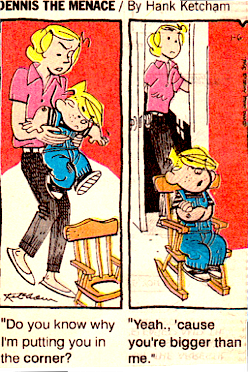
They picked us up, we did not pick them up. They put us in the high chair or the car seat whether we wanted to or not. If we think about how a house is built, we know that pouring the foundation is the first step that determines where the walls go and eventually the roof. In our foundation experience we had little say and our adult thinking rests on that. I wrote about this earlier when I mentioned that the adults were role models of emotional irresponsibility. Recall the sentence: you kids are driving me up the wall.
I think this is embedded in our cultural norms. I just saw an ad about some supplement that began, take charge of your health. Or another ad that began, take control of your credit cards. Doesn’t this suggest that the underlying assumption is that you are not in control, that you are not in charge. My question is who has been in charge of your health, if not you? Who has been charging items on your credit cards, if not you? Many “helpers” or “help programs” emphasize that the first step is taking control of your life, suggesting that you have not been in charge so far. How can one take charge if they are operating themselves from helplessness, i.e., not in charge? As I explained earlier this is why I begin from the assumption that the client or student is already in charge. I talked to the client with the temper issue as the doer, the nail biter as being in charge.
A psychiatrist, William Glasser, points out that in most behaviors we frequently use do and doing. As an example, in answer to the question what are you doing, the person might respond with I’m doing some gardening or I’m doing some housework. Alternately, we can skip the do and doing and simply use the word ending in “ing” such as I am gardening or I am reading, which implicitly seems to suggest the person’s active involvement. When it comes to feelings, the question is not what kind of feeling are you doing, but how are you feeling? Or what kind of feeling do you have? The answer is usually not an “ing” word but instead a descriptive response like I am angry, I am sad, I am hopeful, I am worried, or I have this feeling that something bad is about to happen, with no sense of the person’s active involvement or ownership. Glasser suggests that we shift to “ing” words for the feelings that we are doing. For example, he would use words like I am angering, depressing, guilting, etc. Although awkward it would more clearly make the point of ownership and lead us to minimize our doing negative feelings.
Why is this significant? When we are doing gardening, we can stop gardening or continue, we are at the wheel and steering. When we are in the back seat of our vehicle making comments about what is happening to us, especially when we use sentences like he makes me so mad or she makes me laugh, apparently no choice involved, except of course, the choice to give voice to the passive sentence. It’s as if the other person is the puppeteer and the individual making the statement is the puppet! When we make sentences reflecting passivity, we end up sentencing our selves to the position of doee, rather than the doer.
Remember the unusual starting point that due to circumstances beyond my control, I have been left in charge of me, how about you? I want to ask you who does your eating, your breathing, your thinking, your dressing, your reading? Clearly it is you and you can change what you are doing. You can eat more or less, you can speed up your breathing or you can hold your breath for a couple of minutes, you can change your mind, you can change your clothes, and you can change what and how much you read. If you have been left in charge of you, where does it say everything except feelings? The predominant cultural story is that feelings “happen” as a result of circumstances, especially how other people are “treating you.” Since we seem to be in the back seat and other people make us feel different ways, we have to either get away from them or make them change, whereupon we run into our impotence to convince them to act differently.
The result is we live in the illusion that we are emotionally at the effect of others rather than living responsibly, owning our choice, a much more positive illusion. What if we changed our illusion 180 degrees and played the game of life as if we choose our feelings (our emotional behaviors), similar to how we choose what we do in all our other behaviors? What if we operated our emotional behavior in a manner similar to how we operated the remote control for the TV set? In the latter case we watch what we enjoy and skip the programs that we do not enjoy. In our emotional behavior it seems as if we dwell on our worries and hurts and skim past the “feel goods.” Many people end up “medicating” themselves with alcohol and other drugs as well as food in an attempt to feel better.

Allow me to sketch out an analogy that you might use to run your self more enjoyably. Imagine the following in terms of physical pain and pleasure. If I accidentally touch a hot burner on a stove, I will immediately jerk my hand away because of the pain. 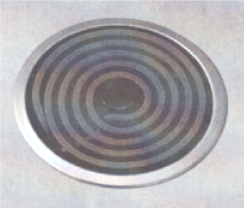 I will not debate should I or shouldn’t I, or start wondering who turned it on. My movement away is immediate.
Now suppose I am petting my dog or cat, or touching a satin or velour pillow, I may continue this behavior for some time. Why? Because I enjoy the sensation (and I am in charge). Of course, I will eventually stop, whether it’s to answer the phone or simply because I’ve had enough. However, there is no urgency in the stopping. In this model of physical behavior, it is clear 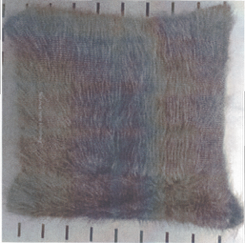 that we tend to interrupt pain and extend pleasure, similar to how we operate the remote control of the TV.
In my presentation of this idea to clients and students, I may use a couple of sheets of paper to represent the burner and the velour, with rapid withdrawal from one sheet (pain) and lingering on the other (pleasure). Then I suggest that we usually do just the opposite when it comes to our emotional behaviors, extending time on the burner and minimizing time on the velour.
That may sound bizarre, yet it seems to be embedded in our cultural heritage. Think about the Puritans, they seemed to be postponing their happiness until they reached heaven, not now. From what I read, their motto might have been, stamp out joy now, wait until later. Since we are living “downstream” from them, it is no surprise that we follow some of the residuals. How does this show up? One way is that we live in a “as soon as” mode. Starting as youngsters we might say as soon as I get into high school, I’ll be happy, followed by as soon as I graduate, I’ll be happy. The flow continues as soon as I get a job, as soon as I get a new car, as soon as I get married, as soon as I have children, as soon as I get the college expenses paid off, etc. The next to the last one is as soon as I retire with the last one, as soon as I get out of this nursing home. We can live our whole life in this anticipatory mode, of happiness just around the corner, reaching a goal is followed by a new goal where the payoff is equally transitory.
Another aspect of our Puritanical heritage is our distrust of feeling good. This is revealed in statements such as the following, I’m feeling too good, this can’t last, I’m going to have to pay for this, I’m waiting for the other shoe to drop, I’m wary of feeling too good because I know there will be a downer following it, etc. We’ve absorbed this attitude and behavior as we grow up and spend precious little time on feeling good, quickly removing our hand from the psychological velour. This is similar to using the remote to find a program that we do not enjoy.
When we use the remote to get on psychological pain, we tend to extend our time on the burner. There are a number of burners-—guilt, depression, worry, jealousy, anger, apprehension, envy, to name a few. How do we extend the time, by analyzing, going over and over the topic attempting to figure out the how, what, and when as well as how it could be different. An example might be when a person has an argument with their spouse at breakfast and then spends considerable time going over it (hand on burner) when they are in the car alone, yet blaming the spouse for their upset.
Further, on the way home, they are likely to spend their drive going over it again, Wouldn’t you think that if it were the spouse that is responsible, wouldn’t the spouse need to be present. If the driver realized they were at the wheel, they could turn the channel to something more pleasant like music they enjoy. That would be revolutionary, wouldn’t it? Possible, but not if you’re operating your self from the back seat.
I like a quote from Oscar Wilde,
“Life is far too important to be taken seriously.”
In my interaction with clients, I will invite them to consider joining me in doing some delight as we talk about serious topics. I might say that we will talk about serious subjects but we don’t need to do grim. I once gave a talk at a psychological meeting with the title: “The importance of not being earnest in therapy.” The blurb accompanying the title was, Marlowe asks the question, if you’re a serious therapist, who needs you? He explores the use of comics and humor, even whimsy.
Since you’re likely to be doing seriousness about what you are reading, you may question the appropriateness of my approach to dealing with clients “in distress.” Here is my rationale. The typical client (if there is such a person) is not feeling good and they want to feel better. That is the bottom line, they want to feel better. Unfortunately, they are typically operating themselves from the back seat where they are at the effect of circumstances or other people. They are blind to their internal sovereignty. My approach as a coach or consultant, that they have hired, is to invite them to consider using their own inescapable power on their own behalf. Notice I use the word invite since I am unable to teach them or to convince them. I’m even impotent to influence them in the least because they have been left in charge of themselves. Once I say what I say, then the client makes up (or interprets) what I said, in so far, as the client is concerned. Clients who create value for themselves tend to continue for additional sessions. Clients who do not make up value simply do not make additional appointments, clearly a case of self-selection.
My thinking is very different from the way I thought when I first became a therapist. At that time I thought I had to be very careful about what I said. It was as if I had to be cautious about what I said because what if said the “wrong” thing, the client might go over the edge. I was operating my self as if I was in charge of the client’s mental health. As a result of this early thinking, I was very up tight in my interactions. This led to a somewhat laughable situation, a client who was uptight sought “help” from a person who was uptight, obviously ridiculous. After I changed my mind, I felt free to say what I thought and left it up to the client to make up whatever they wanted. Thus, I began to enjoy my sessions with clients. Instead of role modeling “uptightness”, I naturally modeled ease, an invitation for the client to do ease as well.
TIME ON THE FLOOR
Mr. and Mrs. Tall Short
I also became more creative in my coaching, sharing hints, tips, and suggestions for the client to evaluate for their utility. One kind of silly example that comes to mind involves a couple in marriage counseling. The husband was well over six feet and had a deep baritone voice. The wife was petite, barely over five feet. When they got in a argument, he would stand over her and loudly make his points. She would intimidate herself and often end up crying. Of course he blamed her for his anger and she blamed him for making her cry, they were totally unaware that they were choosing their emotional behaviors. I asked if these arguments ended up with constructive results and they both agreed that it was more destructive than constructive. Next I asked if they enjoyed these verbal bouts. Both agreed that they weren’t enjoying themselves during the process of arguing.
I then ventured that if arguing was not productive and also unenjoyable that it would be a gift to both of them if they ceased doing that activity. I then talked a little about how two people can see the same movie with the same sights and sounds and yet create different reactions and interpretations.
Further, that neither one could convince the other that they were wrong. Given this futility, wouldn’t it be wonderful to be listened to and not told that their position was ridiculous or wrong? Then I shared the comic about the observer and the worker, when the observer said, “I wouldn’t do it that way if I were you.” I ended this part of the discussion with comments that both were right, for themselves, but not for the other. Further, that we, as a culture, have an addiction to “being right,” at the expense of feeling good.
Lastly, we can go to the mat about being right or we can have a good relationship, we cannot have both.
As I listened to this situation, I said I had a silly idea. I stated that I thought I had a possible solution but that it was a little bit ridiculous, but probably not as ridiculous as arguing when it was not enjoyable and had no constructive pay off. When I saw interest, I stated that the husband had a deep voice and that was not going to change and there was nothing wrong with his stating his position forcefully. However, speaking of position, I suggested that at the very beginning of an argument, and they both agreed that they knew when they were starting down that track, that the husband would lie down on his back on the floor and do his “presentation” from there, while his wife stood up next to him. As they imagined this scene, they both smiled and thought that might be useful, even though it was kind of weird.
At the next session they both were smiling as we got started. They reported that they had become very alert to the movement toward arguing and thought about the ‘‘gift” of not going further. The wife said it was most enjoyable when she heard his voice starting to get loud and she would simply point to the floor and they would both laugh. Of course, we had also talked about due to circumstances beyond our control, we had been left in charge of our selves (and we can interrupt)! What a neat set of “I turns” with ease, simplicity, and quick positive results. What about the future? That is up to them. Mr. and Mrs. Tall Short may reenter their old pattern momentarily but it will never be the same.
If you have read this far, I imagine that you have chosen to do some curiosity and would like some more examples. I will continue in that direction and it will become more clear that there are no standard situations and solutions. The basic idea is to develop alternative ways of looking at the issues based on the premise that the person is in charge. In a way the goal was to use one’s remote to interrupt the behavior that was painful or unproductive, get off the burner. In the first two examples, Bill, Jr. and Ruth, they simply saw an application of the concepts to dealing with his father and her biting her nails. The same is true for Ralph Holder with the soda cleanup. With Burt McTemper it was a situation where he was a client and we explored different ways of interrupting his issue.
PROCRASTINATING SMOKING
Ed Noquit
The next client, Ed Noquit, (I did not use any real names for my clients), had several issues. The one he focused on mostly was his well developed skill of procrastination, affecting his work performance as well as getting behind on his bills and chores at home. Another issue that he had “appeared” was smoking. He had been trying to quit with little success. Of course, “trying” to quit is very “trying” and did not result in quitting. As he talked about these two issues, I thought about an idea that might appeal to him. Since he had identified himself as a world class procrastinator, I wondered out loud if he could use procrastination to his benefit. He seemed surprised and intrigued so I continued in a manner that can best be described as improvisational theater. I pointed out that he was not smoking at the moment and that after he left he would have to light up in order to smoke.
With his unusually well developed procrastination skills, I asked him what would happen if he simply procrastinated lighting up? He smiled and said he wouldn’t smoke. He decided then and there that this would be an interesting challenge. He added that he knew that he would be reaching for his cigarettes and have urges to light up, but that would give him plenty of opportunity to practice his skill. I joined in and said that a lot of people talk about the difficulty and distress of going “cold turkey.” I invited him to delete the word, withdrawal, and replace it with the idea of his body waking up to a nicotine free existence. He might have headaches or feel dizzy but welcome these signs as indications of being on the way to doing himself differently in a healthful manner.
This is kind of bizarre and not generally applicable, however, over the next few sessions, Ed reported that he was pleased that he could use his procrastination skills to his advantage with the result that he was not smoking. In addition, he thought that focusing on his use of procrastination made it possible to distract himself from much of the discomfort in his changeover. He also said that he was not procrastinating as much at work and home chores. In effect, he had moved from the back seat into the driver’s seat! He was living his life in a more useful illusion than the one he had been using, the one where procrastination was running his life.
MORE MBA CLASS
Back to the MBA class, about the third session, Benjamin Smart, one of the students decided my approach was too weird and blurted out that this was just a bunch of bullshit. I could see the class members go on high alert to see how this challenge would turn out. I replied that he was very perceptive and agreed that it was a bunch of BS. I continued that his comment was BS and the rest of the professors were also talking BS, and further that the books they were reading were a bunch of made up BS. I went on to say that since all thoughts and ideas are BS, we have a level field. Now the trick is to use BS that is beneficial and skip the BS that does not have utility. In other words, use your freedom to sort for ways of thinking that serve you better than the victim BS.
TRAGEDY
Percy Pond
A couple weeks later, Percy Pond, who had not said much, began talking about the value of some of the BS from the class. He said that just before the semester started their two year old daughter had drowned and he had almost decided that he couldn’t go on and was going to drop out of school. Now he was glad that he hadn’t dropped out because of the value he and his wife had created from some of the ideas talked about in our class.
Without going into details about what happened, Mr. Pond said the idea of being in charge of feelings instead of being at the effect of feelings was central. He relayed that he had been sharing some of the ideas from the class with his wife and over the last weekend they had made some resolution toward getting on with their lives. He said they had been doing a lot of self flagellation and regrets focusing on if only I, or you, or we, had done this and not that, which was spending time on the “burner.” We realized that this was very painful and also did not bring back our child. He said they came to an acceptance of what happened and although that there would always be an emptiness, they had each other. He knew that they would return to the burner from time to time but knowing they were in charge of themselves, they would not dwell there and could keep their visits brief. During his sharing you could hear a pin drop!
PERSONAL HISTORY
Although I did not share the following personal history with the class, I can share an experience that has some similarities that my wife, Mary, and I encountered much earlier in our marriage. When our identical twin daughters were almost three, Mary gave birth to a third daughter. The delivering physician appeared and I was told that this infant girl was severely deformed and not expected to live. Mary was still in recovery and it fell to me to tell her when she woke up. Not surprisingly, I was stunned and felt like our world had exploded. She was anxious because the nurses were avoiding saying anything and when she saw me she asked what was wrong. I had thought that I would be “strong” for her and contain my feelings, however, I began crying and she joined me.
Although the baby was in trouble the doctors and nurses did what they could including keeping her in an incubator. After 2-3 weeks of touch and go she was stabilized and Mary and I were left with finding a nursing home since she needed 24 hour care and we were ill equipped to do that since we had two little ones to care for already. As you read this, you are making judgments about us based on what you might have done in a similar situation. Remember even if you disagree, if you were us, you would make the same choice. And if I were you, I would do what you would have done.
We spent the next two weeks visiting various nursing homes where we saw all kinds and ages of deformities, a very dark experience. I was more “normal” then and put myself through all kinds of scenarios. Our physician asked if I needed medication to help me sleep and I thought that might be a way of dealing with my pain with the potential to become an addict. I thought about drinking myself into a stupor. I also considered suicide since my life seemed to stretch into a dreary gray future. I even considered abandoning the family and becoming a beach bum. The path that I came up with was based on my Viking heritage. I would keep a stiff upper lip, put my shoulder to the wheel and keep my nose to the grindstone. Sounds pretty grim, doesn’t it?
Fortunately, a friend of mine knew a father who had a little girl in the nursing home that we were considering and gave me his number so I could get a parent’s perspective. When I called him, he was very open in his sharing of his experience over the last five years. Several times during our conversation he would say, “Marlowe, you may think this is the end of the world, but it really isn’t.” I think he was trying to give me hope. However, the voice tone conveyed resignation more than hope, as if spoken from the bottom of a well. As I hung up the phone, I turned to Mary and said, “I have just had the best example of what I am not going to do to myself. It is a tragedy to have an infant like ours, however, I am not going to make a tragedy of myself.”
This decision has been key in the way I have chosen to live. My (and your) experience of what is going on “out there” is determined by how we choose to view or umpire the event, not determined by the event. Each of us is stuck in the role of umpire who makes the call, and that call is our experience, i.e., what we make up! And in our own mind we are always “right” although our experience may not match somebody else’s interpretation.
An unexpected plus has been in my private practice where before when I heard some of the terrible stories from my clients, I had intimidated myself since I didn’t have comparable experiences—for example, being raised by an alcoholic parent or being molested or finding the body of a parent who had committed suicide, which were all good justifications or alibis for living a lousy life. Now I had a similar passport, I just chose to not use it.
To provide closure about our third daughter, because of a strong heart and lungs with a functioning digestive tract she lived or existed for thirty three years. She never talked or was toilet trained, had little muscle tone, unable to feed herself and spent her life in a wheel chair or bed since she could not walk or stand because her knees were “frozen” and her feet were bent under, among other signs of impairment. We went to see her fairly often to begin with, however, when years passed and there was no recognition, we slowed down. There was a financial toll, but with help from one of the grandparents, it was not over whelming. When I wrote the check, I would momentarily get on the “burner” since the money could have gone into the twins college fund. I would get off the burner quickly by saying to myself that it provided a great opportunity for me to learn a very important lesson, that it isn’t so much what happens to me, it’s what I make of it internally. As I said, I am the umpire in my life and nothing means anything until I make the call. How about you?
In answering that question, you will answer one of two ways based upon whether you are at the wheel of your “vehicle,” or in the “back seat.” If you are in the latter position, the “event” is driving you. If you are at the wheel, you may initially choose the victim position, and then change your mind which will result in a different experience! Using the vehicular model I am suggesting that as you drive down the highway of life, on occasion you may head for the ditch. However when you get feedback from the rumble strip or the burner, you can easily and gently steer back into a smooth lane.
Earlier when I made the comment that early childhood trauma justifies leading a lousy life, I also used the word alibi and I want to make two points. First, if I were that person, I would do the same thing, since then I would be that person and that is the way they are operating themselves.
Second, I want to say that although we are products of the past, we are not prisoners of the past. Remember we are stuck with freedom to choose. We cannot change the past, nor can we change any of our foot steps up to now. However, we are free to make our next step in a new direction.
SHOE = NOW
Ellen P. Shoes
I would like to share another story about a client who kept the past alive in a way that hindered her interaction with others. Ellen was an attractive divorcee in her early 50’s who had difficulties interacting with others over any extended period of time. She said that she was always worried (doing considerable worry in my book) about being abandoned and gave a number of examples of relationships going sour due to her sensitivity to being left.
Although most of the examples were about relationships with men, she had issues with women, too, just not as often. She had been married twice and was now afraid to date because she said she did not want to get hurt again, which meant to me that she thought of herself as vulnerable. That in turn placed her in the back seat as a potential victim.
I said that this issue seems to be a well established pattern and I asked her if she had any thoughts about when she started this sensitivity. Her immediate response (or alibi from the past) was to relate something that happened to her when she was about four years old. Her mother was pregnant and was going to the hospital to deliver. Her father was a business man who had to travel and they had just moved into a new city and they did not know anybody who could take care of her during the week or ten days that her mother would be in the hospital. This occurred many years ago, before the advent of the drive thru delivery.
The father’s solution was to take her to a convent and have the nuns take care of her. After the mother had been checked into the hospital, the father said they were going for a visit and she would need a small suitcase with some clothes to wear . She thought this would be a festive occasion and she was encouraged to pick out a nice dress and wear her patent leather shoes. They went to dinner and afterwards her father took her to the convent. As she was relating this story it appeared to me that she was reliving the episode all over again (back on the burner).
When her father was leaving, over her protestations, he said he would come back for her soon. The father left and the nun that was to take care of her picked up her suitcase and asked her to come along to her room. Ellen thought her father would return soon so she wanted to stay by the door. The nun who was serious and part of an order, ordered her to come along now. Ellen began crying and resisting. To the nun this probably looked like disobedience and stubbornest so she spoke more harshly and tried to drag Ellen down the hall. At this point Ellen got sick and threw up. What she remembered specifically was the vomit on her patent leather shoes. In addition, the nun made her clean up the mess. As she finished her story she appeared flushed and said that she had just been reliving the whole episode and she thought that this was responsible for the issues she was having in her adult life.
Her next question was how could she get over this negative incident. I indicated that it was part of her past and it was not necessary to get over it, however it was important to neutralize that memory. I ventured a guess about what was happening when she began doing the feelings of abandonment. For example, the person glances at their watch and quickly says that they have to go and then they leave abruptly (at least for her perception). Or somebody has agreed to have lunch and they are late. Or somebody has promised to call and there is no call. She agreed with these examples and gave a couple more. I then guessed out loud that when she next interacted with the person who was late or didn’t call, she was on full alert trying to figure out whether this was “legitimate” or ‘intentional” and a way of distancing. To the other person the questioning might come across as clinging or a cross examination, not very enjoyable. The unfortunate outcome of her attempt to “protect” herself was to produce what she feared, another relationship on the rocks.
So what could she do? I indicated that the pattern she described was well practiced and she was likely to continue, unless she added something. I asked her what would happen if she began to do her fear of abandonment and she looked down at her shoes and realized that they were not patent leather. She seemed surprised and said something to the effect that seeing her shoes was reassuring. In my terminology she used her freedom to interrupt her time on the burner and that felt better immediately. Surprise! I told her that since she had a well practiced pattern, she would have plenty of occasions to practice looking at her shoes and lessening the “heaviness” that she frequently brought into her interactions with others. The short version of this is “lighten up.” In subsequent sessions she indicated that she was enjoying her interactions with others more, not being so serious. She was especially pleased to hear feedback that she was more fun to be with or that she had more of a hang loose attitude. She also was pleased that she was in charge of her feelings so she did not need to do all that fear of being hurt, especially because she was no longer vulnerable, she was in charge of her self.
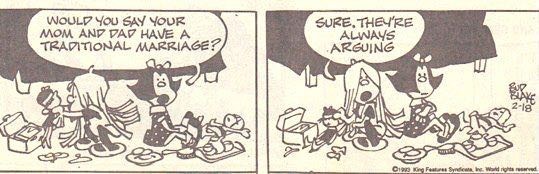
Before I leave this area, I want to make a couple of comments about the nun. In line with the “presets” that I wrote about early on when I was discussing Dave, the homeless man finding the money, that you used to determine whether he was a sucker or a hero for turning in the money. It would appear that the nun was looking through a lens or preset that children should be obedient and if they weren’t they should be dealt with firmly, if not harshly. Had she “done” a more nurturing preset, she would have tried to sooth the little girl who was so distraught. Same situation, both “right,” yet very different depending on the eye of the beholder. Of course, if I or you had been the nun, we would have done the same as she did.
REVIEW
What do all the examples of implementation have in common? And there are more to come. I have written a considerable amount of BS about the underlying fundamentals that make it possible for individuals to create a major shift in their feelings, quickly and easily. To begin with, they all were relatively unaware of their internal sovereignty regarding their emotions or feelings. Although they were at the wheel all along, they thought or pretended that they were passengers and other people or circumstances were in the driver’s seat. For Bill, Jr. it was his father’s behavior of telling him what to do and Bill, Jr. resented “being treated like a child.” For Ruth, the compulsion to bite her nails was in the driver’s seat. Neither of them had mentioned any problems in class but they heard something of value in my introductory remarks (BS) and checked out the utility on their own and were surprised and delighted with their breakthrough experiences. In a sense, they “discovered” their own hands firmly grasping the steering wheel and then it was simple and easy to steer in a way that served them better.
Burt McTemper hired me as a consultant to coach him about “controlling his temper that had gotten him in a lot of trouble.” I let him know right away that I could not help him, I just had a few tips that he might use. I asked him to imagine that he did not do bad temper for various periods of time with the implicit idea that he was doing, not having, a bad temper, that the bad temper did not take over. Then it was simply a matter of inviting him to do interrupts when he began doing his temper. He felt a little weird when he realized the steering wheel was in his hands, however, the payoff was immediate and valuable, thus self reinforcing.
Ralph Holder had been living his life as if incidents, such as a spilled soda, had been running his emotions. He had heard my BS about being in charge of his emotions and at the beginning of his build up of his rant, he remembered the idea that he was at the wheel. Upon “discovering” the wheel in his hand, he immediately steered out of his rant (the ditch) and unto a smooth lane and attempted to reassure his son that he was done being an explosive ogre. Of course, the son was young and not in charge so his father’s reassurance fell on deaf ears. The lesson is that we can invite people to change their feelings but they will decide and the son had enough previous data to be distrustful of such a chameleon like change in his father.
For Ed Noquit, it was his smoking and well practiced procrastination that seemed (at least to him) to be steering him. Although I couldn’t teach him or convince him to view his “bad habits” in a different way, I could invite him to imagine these patterns in a different and useful light. I was sort of teasing him with the challenge of demonstrating his skill at procrastination by postponing lighting up the next cigarette. I already saw him as a person in charge of himself and he did enough curiosity about this new arrangement to discover the wheel in his own hands. As he moved through this process he seemed to revel in his procrastination so that he didn’t focus very much on the usual difficulty of withdrawal and cold turkey.
For Mr. and Mrs. Tall Short, the couple had collected a great deal of data about the futility of arguing while not realizing that they did not have to continue, each was operating as if the other person was pushing their buttons. They agreed logically that it was unproductive and a waste of time and yet they continued this pattern, talk about automaticity being outside of awareness. Due to the size and volume difference, I thought it would be fun to invite them to take up different physical locations with him presenting from the floor. They saw the humor, and the very quick payoff, and started smiling. As we went through several additional sessions, they realized that they were in charge of themselves and not the other. As they stated along the way, we’re having discussions rather than arguments. Not that we resolve everything but we are much more respectful of each other, as well as ourselves.

Percy Pool and his wife were dealt an awful blow when their daughter drowned. They have to do some grieving and each individual does it in their own way and their own length of time. During the time they felt overwhelmed, he was exposed to some ideas (BS) that he related to his wife, and together, they made use of the burner concept and the notion that they were in control of how long they would linger. It sounded like they had some quality talks and were available to each other. The umpire story was also utilized which clearly points out how important it is to be aware of having the steering wheel in our own hands, not in others or in fate.
Ellen P. Shoe had been living her life as if other people’s behavior was ruining her life, which meant that she was in the back seat. Her poignant story of her experience at the convent indicates that she had a good reason for continuing her apprehension at being abandoned. I invited her to look at her shoes as soon as she began to feel apprehensive. She used this “interrupt” as a demonstration to herself that she was at the wheel in the now and this made it possible for her to interact without diving all the way into OMG, it’s happening again.
To sum up, most people are unaware of their internal sovereignty for their emotional behavior. They are already in control, since they grew up. However, their early experience of being “operated” by the giants and very few role models of ownership, results in the cultural norm of victimology. In addition, they have been making emotional decisions robotically based on their early history and outside of awareness. I have enjoyed my career of dealing with people who are pretending to be victims until they “discover” their own hands on the steering wheel.
Another impediment to change is the belief that change takes a long time, is very difficult, complicated, and is also unenjoyable. Who wants to attempt a struggle like that? I would like to suggest a different model of change that I see demonstrated in the behavior of the people described above. How about quick, easy, simple, and enjoyable? I know that is not the cultural norm and many of my clients, students, and seminar participants have “accused” me of making change sound simple and easy, i.e., not being realistic! I suggest that what you say is true, for you, since you are the umpire and you are “stuck” in control.
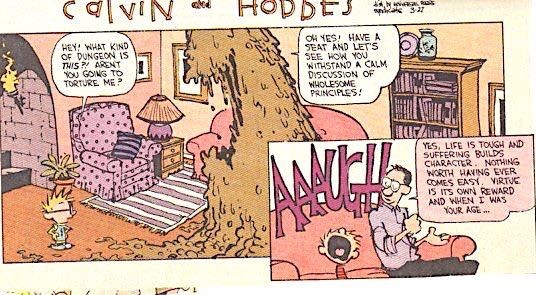
Remember our current cultural tone is downstream from our Puritanical heritage. Listen to Calvin’s father talking to his son about wholesome life principles. The father who loves his son asks him to sit down and listen. He listens and his reaction is to emit a howl like ARGGH! If you haven’t heard some version of this from the people who love you (parents or other family members) or are interested in your welfare such as educators and clergy, you must have been brought up in a bubble.
If you look at that statement where suffering builds character, it seems that if you want character, you should seek suffering as the method of achieving it. What do you get, suffering! How about nothing worth having comes easily? Once again there is an implication that anything that comes easily is of little or no value, sort of out of bounds. If you have sentenced yourself with a statement similar to the statement that Calvin’s father made, remember, you will serve that sentence, and defend it by calling it being realistic. The individuals who made quick and easy major changes might now say that they are the ones that are being realistic.
I would like to describe another comic that I think captures what I have been writing about. It is a Gary Larsen one panel drawing and the scene is obviously Hell. There are five figures in the picture, two devils and three workers. Of the three workers one has a shovel and a second has a pickax and both look worried and are sweating profusely even though they are not working. The third is pushing a wheelbarrow loaded with lumps of coal—and he is whistling!!! And doing his job. One devil is saying to the other devil, “You know, we’re just not getting through to that guy.”
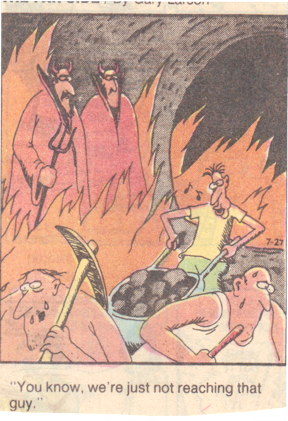
Once again, it is not the circumstances, it is once more what we make up about the circumstances that we experience. Remember, we do not have any chains, that is unless we imagine chains and limitations. We are “stuck” with freedom to make up what we choose.
It would behoove us to choose wisely.
SELFISHNESS
I would like to write a little about this concept and expand it so, like procrastination, it is not all “bad” or useless. I think that like the continental divide, there are two facets to focus on. Like the divide, water on the west side of the mountains runs into the Pacific and the water on the east side runs into the Gulf or Atlantic. I view one aspect of selfishness as avarice and greed where if I grab more, you have less, or vice versa. This side results in competition and conflict.
What if there were another side of selfishness that had to do with taking care of self—with no cost to others? An example would be when Ralph Holder began to wind up and rant at his son about dropping the soda can, he interrupted since he realized he was at the wheel. He smoothed out and said no problem while he was mopping up what he could. Isn’t that selfish of him to do that, to take better care of himself and feeling better? There was no cost to his son, in fact, it was more of a gift! When Bill, Jr. took better care of himself while talking to his father, that was a gift to self as well as a gift to his dad since he was not yelling back—it was even mystifying to his wife. Also when Ellen P. Shoes selfishly took better care of herself, she was more enjoyable to be with as far as others were concerned.
When I look back over my interaction with my clients, I “see powerful” people presenting themselves as powerless in that other people or circumstances are making them feel bad. The reason they come to talk to me or other professionals is that they want to feel better. Isn’t that selfish of them?? Of course, it is. Much of the time the client was interested in getting some techniques to change others. How do I get my son to do his homework? How can I convince my boss to give me a raise. How can I get my husband to listen to me? How can I get more cooperation in raising the kids? On and on. Stop drinking, less or more sex, less temper, quit smoking, etc. Why do they want other people to change their behavior-—so they can feel better! That seems somewhat selfish and the problem is that they have little or no leverage on others to make that happen. They have gathered a great deal of evidence for their impotence with others, yet they remain unaware of the other side of the coin—that others are impotent to make them feel angry, disappointed, good, joyful, hurt, humiliated, etc.
Shirley Edge came to see me because her mother in law was driving her crazy. She went into detail about her behavior, calling at all hours, criticizing every thing she did, drinking too much, on and on. One of my client’s statement was that the mother in law had her on the edge, that she was on the verge of going to the booby hatch. After she slowed down a little I said that it seems like your mother in law is in charge of your mental health. She seemed to agree when she responded with, yes, she’s got me on the ropes. I then stated that since the mother in law was in charge of her feelings, that she should send in her mother in law to see me and I would tell her how she should act so that you can feel better. She looked askance at me and said the mother in law would never come to see me. I then ventured a guess that she was out of luck since the mother in law, the source of her problems, would not come to see me. At that point she slowly said that she guessed it was up to her to learn how to take better care of her self. I responded with I guess that would be doable and began sharing ideas based on the idea that she was in charge of her self. Since she began to think of her self as being at the wheel, and hence less vulnerable, she felt better and even saw some humor in some of her mother in law’s behavior.
So what about the possibility of feeling better before others or circumstances change? For most people who are envisioning themselves in the back seat with somebody else steering, that would seem not only impossible but ludicrous and ridiculous. With all that discussion, arguing, bribing, pleading, threatening, crying etc., with no results, it doesn’t occur to them that they don’t get to vote on somebody else, that they are impotent to change others no matter how hard they try. They would say they are frustrated (not doing frustration) and ready to give up, but when they think they see an opening, they try, try again.
If they could understand and accept their impotence with others, (and others with them) they could stop doing frustration. Not only that, but it might occur to them that this is a two way street. If they are unable to change others, wouldn’t it make sense that the other person is unable to change or affect them. If they had that thought, they could lighten up and take better care of themselves as Shirley did-—before any changes in the others. Radical and impossible. If I gave up trying to get them to act better, they would just get worse. Maybe and maybe not, however, in the meantime you could feel good and isn’t that what you are after? If the guy with the wheelbarrow can whistle in Hell, couldn’t you be more gentle and kind to your self? Bill flipped over to taking better care of himself before his father stopped telling him what to do, an effectively selfish change within, which could be a gift to his father since he wasn’t doing anger with his father. In a way the people who come for “help” are ineffectively selfish and since I can’t help them, my coaching “invitation” is to provide tips and hints on how to take better care of themselves (become more selfish). I don’t see people who are already effectively selfish in the way they operate themselves, why would they bother?
TENNIS ANYONE?
Perhaps an analogy would be useful. Even if you have never played the game, I am pretty sure that you know that it takes at least two people, two rackets, a can of balls, and a court with a net. A serves or hits a ball to B and B returns it to A, etc., until one misses, whereupon another ball is put in play. No matter how often people have been playing together on the same court, if one player shows up without his/her racket, it will change the game, they will not play tennis. I don’t know what the new game would be called or how it will be conducted, but it will not be tennis. Imagine that player A was without his/her racket, they have not only changed self but they have changed the game. They have not changed player B at all, however it is a new game and B will adapt, as will A. Bill changed himself, (he did not bring his usual racket of pretending he was at the effect of his father) and his dad will adapt to the new game. Bill’s wife recognized that there was a new game even though she could hardly believe such a quick change.
Later I will refer to this analogy when the topic is marriage.
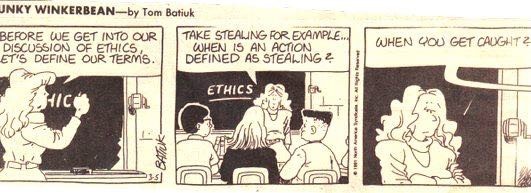
MORE IMPLEMENTATION
Sue Waters
And more transformation. Sue Waters was a seminar participant who was very skeptical about the ease and quickness of change. Of course, she was right, for her, she practically stated something similar to Calvin’s father, nothing worth having comes easy, as well as that change can’t last. That was her sentence and she was serving her sentence. Her challenge to me was about getting her two and half year old daughter to change because she (the daughter) was frustrating her. (Who is in the driver’s seat?) I didn’t ask her that question but did ask for more specifics.
Sue described one of the “frustrating situations” that occurred at bedtime. She gave her daughter some water, tucked her in, kissed her good night and shut off the light. Within minutes the daughter was asking for a drink. Sue would be busy with dishes or the phone and that didn’t matter to the daughter. She was so persistent that eventually Sue would bring her some water, just to get her quiet. I asked Sue to picture herself walking down the hallway with the water. In response to my question about what kind of feeling she was doing (not feeling) as she was walking, she used the words, angry and frustrated. From her description I said that I could picture that and that she was entitled to do those kinds of feelings. Her response was that she was not doing those feelings but they were caused by her daughter’s obstinacy. I said I understood what she was saying but that I wasn’t sure that the daughter was the cause.
Next I asked her to imagine herself walking down the hall with the water glass in her hand and smiling. She smiled as she said that would be really different. I suggested that it might be worth experimenting with, just do that a time or two and see what results from your change. I thought to myself she has already done it mentally at my suggestion, a sort of dry run.
At the next meeting when I asked who wanted to share how they had changed their lives, Sue volunteered. She said she had thought about smiling and looked forward to walking down the hall smiling. In fact, she was washing dishes and hoping her daughter would not forget and call soon. As she walked down the hall toward her daughter’s bedroom she felt a little silly, which was better than feeling (doing) grouchy and frustrated. Her interaction with her daughter was very different (since she didn’t bring her racket). She felt that they had a good visit rather than the preaching and exasperation she had previously done about how the little girl did not need more water and had already been tucked in, so she should just go to sleep and quit making a fuss about the water, especially since she had already had something to drink. Sue changed the game or interaction when she changed herself!
MORE ABOUT THOUGHTS
I would like to share a little more about thoughts before I proceed to more examples of implementation. First I would like to ask you where you went to high school. The majority of those who have read this far will retrieve (see) the building in their mind’s eye. Next I will ask you to remember your favorite teacher although it is possible that some of you do not have one.
Many of you will not only remember the name but will visualize the person and perhaps even “hear” that person’s voice. Next up, who was your least favorite teacher? Again see and hear that person. Now in addition to sight and sound, you also probably did a feeling associated with each teacher, positive with the favorite and negative with the least liked.
I suggest that our thoughts are a combination of seeing, hearing and feeling, which I term or call video, audio, and feelio. (You know I made up that last word.) I will add that various individuals will vary in the manner in which they think with some emphasizing video, others focusing first on audio and others feelio. Just a reminder, I am making this BS up, and it might even have some potential or utility—of course, that will be up to you, as usual.
As I share this with clients and students, I ask them to visualize some scenes. The first is to walk along the beach seeing the waves rolling in, hearing the surf and feeling the wet sand on your bare feet. When I ask what feelings are you doing, the most likely answer will be terms like relaxed, serenity, peaceful, etc. Of course, there are people who do not like the beach and talk about the sand blowing or the flies bothering them and then I offer the choice of a float trip or mountains. I then ask the person to come back to the present and then describe a different scene like the stabbing scene in the movie Psycho where most will create the experience of fright and horror. A third scenario could be telling a joke that has a surprise ending and the feelio most likely would be laughter. The last scenario involves walking in a run down part of town on a very hot and humid day. You glance up and see the Goodyear blimp so you are not watching where you are walking. Suddenly you step on something soft and you lift your foot, look down and realize it is a dead rat and it has been there for several days. You can see the maggots and smell the rotting flesh.
That scene is usually followed by words like repulsive, sickening, revolting, etc. In the space of a few minutes, most people have experienced four different emotions: peaceful, horror, laughter, and disgust, two positive and two negative, or two velours and two burners..
I would like to point out some things. Did you notice how real those emotions felt? As real as any emotions you have ever done. And did you notice that there was probably no beach, no stabbing scene, no joke and no dead rat in your immediate surroundings? All you need is your imagination. Is there ever a time when you are not imagining what is going on? An interesting question and I will have more to say about that later.
Did you notice you can do only one emotion at a time, just as you cannot sit and stand at the same instant, only sequentially. Also, you can change your emotions quickly depending upon what you are imagining or thinking about. And changing emotions does not require “hard work”, it is much like using the remote to change channels. However, since we are in charge of our self, we can use our power to pretend that we are powerless by sentencing ourselves in the following manner, I can’t get rid of the feeling, I can’t change my feelings, I don’t have control of my feelings, etc., and we will serve our sentence! The latter is the cultural norm, feelings are not chosen, they happen to me, and I will add, they (the emotions) just happen to be at the wheel and they just happen to be steering, as in my temper took control. In addition, those feelings are caused by other people or circumstances, so I am not responsible or response able, hence unable to use my remote and change my feelings.
Another point—the video, audio, and feelio are all involved together as we think our thoughts. I will sometime hold up the middle three fingers of one hand to represent the trio and move the hand around. As I move my hand, I point out that although they are somewhat separate, they are joined and always “travel” together. What is the value of knowing this? Answer: if you don’t like the feeling you are doing, change the video or audio you are doing, like Burt McTemper when he was building up his anger when he thought of the priest or cartoon. Of course it helps to be at the wheel or have the remote in our hand, not in somebody else’s hand. Pick your illusion, you will live it.
There is an old joke about the patient who goes to the psychiatrist and says, “It hurts when I keep hitting my head with my fist. What do you recommend?” The doctor responds simply, “Don’t do that.” It is that simple but often dismissed with, that’s easier said than done.
I was reading a Dear Ann type column and the daughter who was writing about her problem had recently discovered that her father had been having an affair. She goes into some of the sordid details and the “impact it made” on her and her mother. That sentence places the father’s behavior in charge of her feelings, she is not responsible. She ends with “How can I get over this betrayal, anger, humiliation, and sadness?” The response is right on saying that if you act like the victim and keep “wishing” it were different, “you’ll keep renewing your disappointment and grief in perpetuity. The power lies with YOU!”
MORE IMPLEMENTATION
Nell Raped
Nell Raped was a graduate student in her mid twenties who came to see me about a couple of issues, writers block and a phobia. We had 10-12 sessions and she listened to my BS and picked out what was useful for her and resolved her issues to her satisfaction. Almost a year later she called me early in the morning to tell me that she had been raped the previous night. I asked if she wanted to come in later that morning and she said no because she had been up all night between the police and a trip to the hospital and needed some sleep now, so we made an appointment for the next day.
When we met she told me what happened which began with her walking home alone from the local tavern because her husband was there having fun playing pool and she was tired. She was a little tipsy and didn’t have a care in the world but thinks she was followed. She may have left the door unlocked, expecting her husband and went directly to bed. As she was falling asleep a man burst into the bedroom, pinned her down and began raping her. She struggled and thought she had scratched his face but he was much stronger and put a pillow on her face with such force that she was suffocating. She thinks she lost consciousness but recovered enough to hear him leaving.
The police kept asking for a description but the bedroom was dark so she did not get a good look at him. The staff at the hospital did an examination and took some swabs as well scraping under her fingernails, which took the rest of the night. She had called the police and then a girl friend next door who ran to the tavern and told her husband. He returned and grabbed a knife and went out in the dark to see if he could find somebody with a scratched face. Her girl friend was practically hysterical and my client said she acted like she was the one who had been raped.
As she related these events, she seemed fairly composed, certainly not agitated. She said that it was fortuitous that she had used some of the tools that she had learned (not taught) in our previous contact. She stated that it was over for now and it would be some time before she would know if she were infected or pregnant but she would deal with that at that time and she was not going to spend time doing much worry because it wouldn’t change anything. She had been asked about her experience by some of the people she knew and she said she did not want to talk about it. Her husband had said that she needed to talk about it, to get it out, that stuffing it would finally explode, a typical cultural story. He also indicated that he thought she was repressing the experience or being in denial since she was relatively calm, almost as if he expected her to be a hysterical mess.
Her comment to me was that talking about it was somewhat like reliving it and spending time on the burner. The statement that I remember well was, “No matter how many times I re-rape myself, I can never un-rape myself.” What a great job of steering! We made an appointment several weeks hence and there was more good news about that awful night, no pregnancy or infection along with the comment that she was very pleased with the way she had handled herself in the crisis. I asked about her relationship with her husband and she indicated that the situation between them was quite good. She said she had expressed her wish that he had stayed home that night instead of running around looking for the rapist. He said he realized that and he apologized so that did not come between them. Also he said he was glad that she had gone to counseling because she had gained a great deal that showed in the way she handled herself. She added that he was very understanding about her pace of returning to intimacy which meant a lot to her.
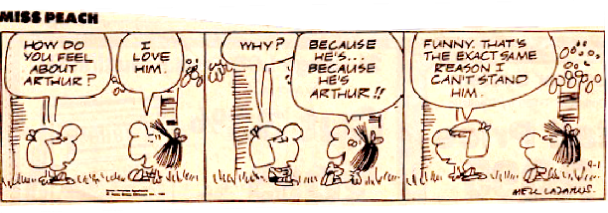
NON-IMPLEMENTATION
Ann deTail
Ann deTail was a 45 year old woman that had heard about me and came in thinking I could help her fix her marriage. She and her husband had been married for almost 20 years and had one teen age daughter. About 5 years earlier her husband had an affair over a summer when Ann was helping her father with a health issue and Ann and the daughter were out of town. I don’t recall exactly how this liaison came to light but this topic became front and center over the next years.
Ann was doing upset and outrage and determined to know all details. For example, she had a calendar for that summer and had written all the details that she extracted from her guilty husband. She told her husband she could not forgive him unless she knew everything that had taken place.
Unfortunately, he bought into this and spilled everything even though there were not many times. Twice they met in a motel and Ann had to know the name and the date. Once was at their house on the couch and a couple of times in the car at a park. What Ann did with this information was to keep it alive. They could not drive near the motel and the park was also off limits. The couch was thrown out and a new replacement was installed, although that didn’t work too well because she said the new couch reminded her of what had taken place. As if the couch could talk. I think the couch was mute but that Ann had a very active mind where she spent hours on the burner.
After a few sessions where I had listened closely and had shared some ideas (BS) about the price she was inflicting on herself, she acted as if she had no choice. I relayed a quote from Albert Ellis, an abrasive psychologist from New York given at a meeting early in my career. “You dumb assholes, don’t you realize that the reason people are feeling shitty is because they are thinking about shit..and they will keep feeling shitty until they change their damn mind.” Incidentally, when I first heard this statement, I judged him to be very unprofessional and created the reaction that he offended me and I was on the verge of walking out. It was only later that I thought it was an excellent statement, partly because it was easy to remember. I modified the inherent principle by talking about burners on a stove with the contrast being velour.
Ann thought that bringing in her husband would help. Sam deTail was not eager to have another whipping but Ann went through her charges again just to review what had happened. She said she felt betrayed and it was up to Sam to earn back any trust. Sam was passive and guilty, or guilty and passive. He asked both of us what he could do to make peace with Ann. I indicated that he could not change her, nor could she change him, because they were each powerful within. I must have been talking in Greek from what I could observe of their comments and reactions. At one point I said that most people wouldn’t sit still for all this interrogation and Ann responded, “He is my husband and he is married to me, so he has to take it. He ruined our marriage!” It seemed to me that she had adopted the role of victim of Sam’s behavior and she was not going to let go no matter what.
Ann held “trump cards” that seemed to give her “power” over Sam and was not about to give up in spite of the unfulfilling marriage. One of the memorable comments made by Ann was, “How can I look at you without feeling disgust?” Five years ago and the “betrayal” was fresh and in the drivers seat for her.
For Sam it was “guilt” at the wheel.
In our last appointment (as it turned out) they made an appointment for the next week, called to cancel, and never called back. Incidentally, they never paid their bill which was fine with me, because of their preset they hadn’t gained any resolution so there was no value achieved. Also, incidentally, if I were Ann, or I were Sam, I would have done the same thing that they did.
Also, I did not agonize about the result, it just demonstrates that this BS is not useful if there is no application, especially when there is a reluctance to experiment with different thoughts. I felt sorry for both of them, how they used their minds for self torture rather than experimenting with change. The result is a major contrast with the way Nell Raped used her mind and thoughts in dealing with her rape!
DISAPPEARING WORRY
Sally Worrier
Sally Worrier was a seminar participant who listened through the first three sessions and in the fourth said she had been trying to tone down her worrying but wasn’t having any success. She described her mother as a continual worrier about every little thing and attributed her worrying to having learned how to worry from her. In other words she was presenting her alibi for her worrying and felt helpless to change.
I asked her if she had any girl friends that were good worriers and she immediately named Bridget as a “bigger worrier.” I indicated that it sounded like Bridget was in a class of her own and Sally agreed. I suggested that she ask her friend the following: Since you are a more proficient worrier than I am, would you do me the following favor, when I realize I am doing worry about something, would it be alright for me to call you and name my worry and have you take on the worry because you are so much better at it than I? Sally laughed and said that it was silly but that she would talk to her.
At the next meeting Sally volunteered that she had talked to her friend and that they had had a good laugh about it. Bridget had also agreed to taking on any of Sally’s worry. The result that she reported was that when she noticed that she had begun to do worry, she would think about calling her friend and then chuckle at the thought. Of course, she interrupted the worrying. In my terminology when she got on the worry burner, she made a channel change thought that ended in a chuckle—and she can’t do chuckle and serious worry in the same instant.
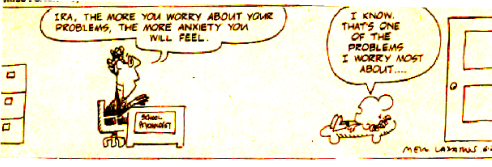
BASIC FORMULA
I have shared several instances of rapid change and implementation based on some non-standard assumptions (and I may do a few more.) First, each person is responsible (at the wheel) for what they internally experience or make up about the world. It is not the circumstances or the people, just their thoughts (umpiring calls) about their unique situation. Second, if the resulting feelio is negative, painful, or not useful, they can shift their audio and video to something else, and thus, their feelings. If the way you feel is not better, keep changing channels, you have the remote. If you think that it is not that easy, you will be right! On the other hand if you think you can use your internal sovereignty to your benefit, you will also be right! Because of the rapid change, you are likely to experience some initial awkwardness as you feel better more and more.
By the way, the reason many people don’t feel good much of the time is that they are so adept at feeling bad.
The statements above are made about the majority of people who are considered “normal” in our culture, whatever that is. What I am writing is probably not very relevant to individuals who are clearly diagnosed in categories like severe autism or schizophrenia. Also what I have written would not be relevant to people in the third world who are starving. I am only addressing the people who have read this far, knowing that it is all BS!
MORE BACKGROUND
A recent article in the Scientific American focused on sight and seeing. I don’t remember the exact numbers but it was something like the following. There may be one hundred million stimuli in your visual field. However, you have only ten million retinal cells so only ten percent of the stimuli can be picked up. Next, the optical nerve has only the capacity to transmit ten percent of the retinal output. So ten percent of ten percent means that our visual cortex is receiving only one percent of the stimuli out there, in other words, a tiny sample! Combine this with the variety of presets and different life experiences and you can begin to appreciate the variety of thoughts possible about anything. When you (and I) were born we did not know anything because we did not have a mind. Now we have a mind of our own that we own and we think we know things, however, we only know and experience our thoughts about things!
You can begin to appreciate the unreliability of so called eye witnesses! I have lived quite a few decades and I have concluded that it is not worth “going to the mat” about much of anything since I don’t know what is going on, I just think I do. Meaning, I make up thoughts about what might be going on, just like everybody else. I refer back to Calvin and Hobbs where Calvin says everybody is ad-libbing their lines and Hobbs says that is why it is hard to tell whether it is a tragedy or a farce. The ending line is what we need is more special effects and dance numbers. I have had a lot of fun in my career as a coach or consultant, as well as my life in general.
APPEARING AND DISAPPEARING
Joe Smoke
If we have been left in charge of our self, then if we begin (appear) a behavior, we can also stop (disappear) that behavior. We are in control. I would like to share another example of this sequence, this time about Joe Smoke who had been a smoker since his teen age years, a total of thirty some years. His wife was also a devoted smoker and they talked about quitting from time to time. Joe stated that he did not think he could quit unless she joined him so he thought of himself as at an impasse (a self made impasse). Of course, he was right!
I suggested that he was not limited and that I had some ideas that might be useful in eliminating what he called his “bad habit.” First I asked about his initial experience of smoking which was that he coughed and felt dizzy and sick with his eyes watering. I stated that he had a great deal of persistence to override his negative experience to become a proficient smoker. Now, he had tried hard several times to quit but he had failed because he was “hooked.” I then told him that I had an idea of how he could unhook himself easily.
My suggestion was that he carry his cigarettes and lighter during his unhooking so that he could light up any time he wanted. He looked surprised and wondered if that was all. I then added the following. Smoke all you want but first you make an agreement with yourself that you will light the cigarette with a five dollar bill. When you put the cigarette in your mouth, take out a five dollar bill and light it with your lighter and use the lit bill to light your cigarette. As you smoke let the bill burn so you aren’t able to light a second cigarette with it. In essence, you will spend five dollars for each smoke. Smoke all you want!
He looked dubious but added that it was worth a try. He pulled a five dollar bill out of his wallet and put it in a special compartment for his next smoke. In the next session he described his experience with his new rule. He said he couldn’t light up in the car while he was driving which was where he had always smoked. He couldn’t light up at work in front of everybody, they would call the men in white coats to take him away. (This occurred in the era before smoking restrictions and he usually smoked several times a day at his desk.) Of course he couldn’t light up in front of his wife so he had effectively eliminated most of the locations of his smoking behavior.
On the previous weekend after three days of not smoking, he decided that he would do a smoke. He went into his detached garage where he could not be seen by his wife. It was winter and he was shivering as he pulled out a cigarette, lighter, and the bill. As he contemplated lighting the five dollar bill, he decided that it was ridiculous and he put the bill back in the compartment. At that point he knew it was over. Incidentally, I ran into him about twelve years later when he shook my hand, reached in his wallet and pulled out the five dollar bill and said, “This is the original and I have saved thousands of dollars.” He added that of course his wife had noticed and wondered how he had stopped. He didn’t tell her about the money but she said that if he could do it, she could do it. And when she thought she could, she disappeared her smoking behavior. More money saved and BETTER HEALTH!!! Weird—and effective.
As you think about Joe and his disappearing of smoking, he basically did NOTHING, he did not light up, and no longer smoked. Look inside yourself and see what you have said about this to yourself. Some will say that they could never do that, or it is too weird, or it wouldn’t work for them—and they are absolutely right! Why? Because they are sentencing themselves and they will serve their sentence. Others might say that is something I could do, it certainly is weird but it is a clever way to change my behavior. They, too, will be right. Like Henry Ford is reputed to have said, “If you think you can or you think you can’t, either way you are right.”
As long as I am writing about smoking, I will write about my experience that I created. This is way back in the dark ages when the media was free to do major advertising about the delights of smoking. Hard to believe but flight attendants passed out free samples of cigarettes as one boarded the plane with the result that everybody smoked on the flight, whether it was first and/ or second hand smoke. In addition the movies of that era had considerable smoking involved and the actors were frequently seen in the ads. Ronald Reagan for Chesterfields and John Wayne for Camels. In addition, my dad smoked 5 or 6 cigars a day.
This was also when I was more “statistically normal” than now. In my early twenties, I “appeared” smoking and continued to smoke roughly 2 packs a day for about twenty some years. As I began, I was certain that I could stop easily, however, as I kept smoking and began to buy into the cultural story that nicotine was addicting and that stopping a strong bad habit like smoking was extremely difficult. In an attempt to quit, I tried pipes and cigars from time to time but that was still smoking. How did I disappear all that? Read on.
Since I enjoyed playing poker, I was one of seven fellows who got together once a month and played from 6 on a Friday evening to 6 in the morning on Saturday. Five of us were dedicated smokers and each of us would bring 3 or 4 extra packs because we knew it would be a long evening and nobody would want to leave the game to get more cigarettes. The haze was such that it was difficult to see the person across the table. Add some drinks and consuming a lot of snack food resulted in more haziness.
You can imagine how I felt on Saturday. My friend Dave, a non smoker, picked me up after a poker night and we went to introduce him to another friend of mine that he wanted to meet. Fred was a smoker and smoked my brand. We were sitting around his pool having a beer when he offered me a cigarette. I didn’t have any since I had vowed to stop smoking once again, not that my vows had meant much. After a second beer I accepted his offer and lit up. I immediately felt sick and put the cigarette out.
On the way home I asked Dave for a favor, to bet me one dollar of his money against twenty dollars of my money that I would not smoke a cigarette for a year. It was June 28th and I think the year was 1975. Dave did not want to bet me but I insisted and he relented. Later that night Mary and I went to a party where there were plenty of smokers. I brought a pack just in case and naturally I had (did) the urge to light up. Fortunately, I had the twenty dollar penalty in mind and did not light up.
Many times I would feel the urge and many times I simply interrupted so I had a great deal of practice. The next morning when I woke up I realized that I was on the other side of the smoking issue, I had disappeared it! I chuckled at my previous efforts to stop when it was so simple, don’t light up—similar to Ruth’s don’t bite your nails. Instead of doing something, it was simply do nothing or no thing.
Of course I still did the urge, especially when somebody else was smoking. Also I had the signals from my body such as headaches, dull sensations in my chest, etc., as I moved into a nicotine free experience. However, I did not call that withdrawal, but instead labelled it simply as my body is waking up, like the “pins and needles” one gets when their leg has gone to sleep. I also saw my disappearing smoking as a “gift” to my self and my health, not deprivation, as well as not being a negative role model for my daughters.
You can also see where I got the idea of the five dollar bill with Joe-— he said he was not a betting man so that’s when I suggested the lighting up with the five dollar bill. One of my clients was very wealthy and he said that a hundred dollar bill would not be a stopper. So I suggested he write a large check to some person he detested and he chose George Wallace, Governor of Alabama. He created that vision as an interrupt and disappeared smoking.
There’s more! A year later, June 28, I made sure to have lunch with Dave. I told him that he owed me a dollar. He seemed puzzled until I reminded him of our bet. He laughed and handed me a dollar saying that he did not think I could do it. I took the dollar up to the counter, got change, and bought a pack of cigarettes, I think they were thirty-five cents. I lit one up and promptly felt dizzy. I reinstalled the program and smoked a carton during the next week. My wife and others were aghast and worried that I would be “hooked” again. In my mind it was kind of a joke because I knew there was no problem ahead of me and I smoked my last cigarette on the fourth of July.
I called Dave and asked him to renew the bet for the next 51 weeks. He said he would give me the dollar now and I told him I did not want it until the year was up. For the next nineteen years I smoked one week following June 28th. I saved the dollars I collected and then smoked a cigarette later in July so that I had “lost” the bet and gave Dave twenty dollars.
Wait. There is more. From time to time during those 20 years when I was smoking for a week a year, I did some smoking cessation seminars, usually in the evening in a church basement. My opening remarks included a welcome and glad to see you here, that is a clear demonstration of mastery. Of course, had you gone to a movie instead that also would demonstrate self mastery, used to attend a movie. I continued with the fact that you light up several times a day is also clear evidence of self mastery—there is nothing but self mastery and you can use it for your self or against your self. Then I would add that before I proceed any further that I would like to make a confession. “I am a smoker at times just like you.” I could see that this was received with a little confusion. At that point I would say, “The difference is that I am a very efficient smoker, I can get all the smoking I want done in one week each year. I would think that you are inefficient smokers since you take a whole year to get your smoking done.” I shared some of my earlier smoking behaviors and then indicated that it was primarily a function of how we think and use our mastery. Of course, a non smoker would think smoking for a week once a year is ridiculous and ask why in the world would you do that. A smoker would more likely ask how do you do that.
At this point I would cover some of the thoughts that I found useful and answer any questions that they might have. I would do a follow up session a week later and the ones who had a preset that I was out of my mind did not show up. They represented about a third of the group. Another third reported that they had done “nothing” about smoking and it was surprisingly easy. The remaining third indicated that they were not ready to quit but that they now knew how to disappear their smoking pattern easily when they were ready.
I want to add a comment, nobody has any difficulty stopping smoking, no matter how long they have been smoking. You see as each lit cigarette burns down to a stub, the person will put it out in an ash tray, throw it out the car window, or step on it, demonstrating that they have stopped smoking. Kind of weird but every smoker has practiced “stopping smoking” as often as they have practiced lighting up. I suggest that stopping smoking is not the issue, doing something called lighting up turns out to be the step to skip, and the person will never smoke again— as long as she/he continues to do nothing or no thing about cigarettes. This is similar to Ruth’s doing nothing about her nail biting. Finished, ended, game over! Probably too simple for most people who are into struggling to build character and nothing worth having comes easily. I have occasionally heard a statement from an ex smoker that it was the hardest thing he/she has ever done. Another statement that I have heard, if I had one puff, I would get (do) hooked again. That brings up the question, who is at the wheel? A cigarette is inert, how can something inert do hooking? It must be a function of thought and thinking!
There is no one program or method that will appeal to everybody. I was a participant in a seminar where the leader asked an individual who was having (I would substitute doing) difficulty with staying stopped to come up front. Next the leader asked if he had a good relationship with his mother and the answer was very good. Then he asked him to look around in the audience and pick out a woman who reminded him of his mother. The leader asked that woman to come up and kneel and put her arms across the seat of a chair. Next he asked the fellow to imagine that this was his mom and there was a guillotine blade ready to fall if he lit up. Could he stop?
The answer was yes!! Again the way to change a behavior that is not serving you, create some kind of interrupt by changing your thinking.
Before I share another implementation story, I want to again point out that most people are unaware of what they “bring” to their judgment and perception experience. I once heard an Aussie begin his talk with the following remark, “You Yanks may have a bit of a problem understanding me from time to time but you’ll have to remember that you are listening with an accent.” Our cultural story about accents is that they reside only in the speaker, never an awareness that the listener has an internal accent during the intake. This is similar to the concept of preset that I began with when I mentioned Dave, the homeless man finding a lot of money and turning it into the authorities. Generally speaking, most people have a preset that will be part of their umpiring call—as to whether he was a fool or a hero. In the next story about a client, you will bring a lot of presets into play as you umpire.
ANOTHER IMPLEMENTATION
Marge Fearful
Marge came to see me about her marriage to an abusive husband. She said she was fearful because she had been told in no uncertain terms that “they could handle their own problems” and she was forbidden to seek counseling. The husband was a construction worker and a heavy drinker who would get angry over just about anything. He was powerful and she was much smaller than him. He would grab her upper arms, lift her off the floor and shake her and often slam her against the wall. It was no surprise to me that she was re-experiencing her feelings as she related this scene. The two girl friends that she had confided in both told her that she had to leave before he crippled or killed her. However she had two children in grade school and no money. This was probably 30 years ago and there were no women’s shelters at that time. She indicated that she felt trapped, that there was no way out. Talk of counseling or divorce was met with anger and a shaking.
What a dilemma, no easy solution in sight. Although she felt helpless, I saw her as powerful within, like all my clients who have been left in charge of them selves. I commented on how fearful and frightened she appeared. She agreed and talked about how she dreaded his return home. Next I made a comment about how traditional it is to attribute their feelings to somebody who is not even there. This was too big a jump when I pointed out that her husband was not in the room and yet she was doing fearful.
Would that suggest that you are creating your own fear now, at this moment? She looked perplexed and indicated that she had good reason to be fearful, look at her situation. I responded with I think you are totally justified in feeling fear, you do have a good reason, however is it useful to do fear in this moment in this office and attribute it to your absent husband? It might even be possible for you to skip doing fear at home! That was too big to digest, I know, however, it didn’t hurt to mention it. (And for those grammarians who are missing and have been missing quotation marks, I don’t use them much because I do not recall all the conversation verbatim, OK? A little humor.)
I thought she seemed perplexed, although that of course is a guess. I also thought that she seemed to be turning that idea around in her mind. Her behavior was to stay, not jump up and leave the office that was in my house, perhaps partly because she thought highly of the doctor who had referred her to me. As she thought about this, I also mentioned that I thought that she might tell her husband that she had sought counseling. Her response was to look more fearful and say that it would just lead to violence. I pointed out that she had never prevented him from turning violent even though she had “been walking on egg shells” and still could not prevent his angry outbursts. She made another appointment. As she left I wondered if she would show up because of my atypical approach.
She did keep her next appointment and had not told her husband about her previous visit. I expanded on some of my reasons for saying what I had said and she seemed interested. She was still jittery but engaged. As we discussed topics like being left in charge of self emotionally, she seemed more relaxed. We made another appointment.
Once again she showed up on time and she had not yet told her husband. A few minutes later the door bell rang and she quickly accessed her fear. I did some apprehension (rather than I was apprehensive) as I walked across the living room to the open the door. As I suspected, there was a stocky man in workman’s coveralls. He was red faced and agitated and blurted out in a loud voice, “Is my wife in there?” I also registered that he had a bulge in his pocket. My first thought was to slam the door and I knew that he had come for a fight and I was no match for him. I said she was and pushed the storm door to open which he grabbed and thundered by me as I stepped aside and pointed to the office. He strode quickly across the living room and I followed a couple of steps behind.
As he rounded the corner and spied his wife, he pointed at her and yelled, “God damn you, I told you not to go to counseling!” I stepped up beside him and said in as even a voice as I could, “Would you like a cup of coffee and join us for awhile?” He slowly pulled his hand down and turned to me as if he had not heard me so I repeated my invitation and I could see his hands relaxing. He turned fully to me, shook his head as if to clear his mind, and said, “I better leave before somebody gets hurt.” He turned and left and I followed him to the door and said he could come back anytime he wanted.
When I came back in the office, Marge was still “sitting small,” kind of huddled. I told her what I had been thinking as this all unfolded. I said that when the door bell rang, I immediately did some video, audio and feelio about an imagined possibility. As I walked across the floor to answer the door I did about 6 or 7 on the fear or apprehension scale. When I opened the door and actually saw what I had been doing fear about, I went to 9 or 10. I saw that he was obviously very angry.
In spite of my urge to slam the door, I opened the outer door, answered, “Yes,” and pointed to the office. When he yanked the storm door open and thundered by me, I followed him. This is the conversation I had with my self as I walked across the living room. Somebody is likely to be badly hurt or dead in the next couple of minutes—and it might be me. My question to myself was, do I want to spend the last minute or two of my life doing fear? My answer to myself was no and I dropped down the scale to about 2 or 3 which made it possible for me to invite him to join us in an almost ordinary voice. Marge and I talked for quite awhile, sort of debriefing, and she made another appointment.
As the time of her next meeting approached, I did some curiosity (as opposed to I was curious) about what I would hear, if she showed up. She was on time and her countenance seemed changed. She related her experience (what she had made up) the rest of that day. She said that she would get on the fear burner momentarily from time to time but that she would interrupt quickly by getting curious about how she would react when he came home, not on what he would do. Doing curiosity is a much better feelio than doing fear. She indicated that she had alternated back and forth many times so she had practiced interrupting many times.
When he came home later he had been drinking and immediately began a rant about her going to counseling. He worked himself up to the point where he grabbed her by the upper arms and lifted her off the floor preparing to shake her. She said that she didn’t do fear and was almost nonchalant when she asked, “Bob, do we have to do this?” She continued, “He seemed a little confused like he had in your office, and he put me down. I was surprised and yet I was not surprised.”
I shared the tennis game analogy with Marge and how the game had to change if one person changed—clearly she had shown up without her racket—she didn’t change him but he had to adjust to a new game.
We met a few more times and she reported that Bob worked himself up at times but stopped short of picking her up. She said she was feeling better and was thinking about looking for a job, even though her husband had forbidden her to work outside the home. After a few meetings she said that although things were better she still wanted a better marriage so she told Bob that either he came to counseling or she was going to get a divorce. His reaction was very negative. He stated that he was not crazy and if she thought she was going to get a divorce, that he would kill her first. Her response was that if that was what he had to do, he would do it, just as if she were still alive she would get a divorce.
It is difficult to imagine a more reluctant client. They did come in together but he pulled a chair into a corner as far away as possible and remained withdrawn. He was ill at ease and said very little. Marge and I talked mostly and I made sure that I did not point to him as the “bad guy” hoping he would get involved. Marge said he was a good provider and loved his two sons but wanted more of a positive relationship with him. It turned out that one time was enough for him and he did not return. She found a job and arranged for her girl friend and neighbor to look after the boys after they got out of school until she got home. There was no further need for us to get together so we left it at she could return at any time. In my view she had changed herself from a frightened woman into a “can do” lady who was gentle within and yet decisive, somebody who knew how to take care of her self, in my terminology, more effectively selfish.
Several years later she wanted me to talk with the oldest boy so I had a chance to catch up with what had happened in the interval since I had seen her. About a year or two after we had talked she got a divorce. She stayed in the house and her ex came by to see the boys or take them with him. He also dropped off money and told her this was for the boys, not for her. She said that he was pretty cooperative overall and that she liked living alone. She had dated some but was not interested in marriage. In terms of work, she had gone into sales and was pleased to share that she was in the top 5% for a national company, complete with bonuses and recognition.
What a transformation or trance formation! Almost any thing is possible when the person is at the wheel while impossible from the back seat! I want to point out that I did not help her, she helped her self. How could I have helped her if I could not teach her, if I could not motivate her, if I could not convince her, and if I could not even influence her???? Her change was due to an expanded awareness that she was left in charge of her self—only she had not “known” that before. She did not gain control—she simply used her control to make an I turn. I was impotent to help her, I could only invite her to use the control she was stuck with, differently. She went from having emotions to doing emotions! I had inadvertently provided a role model for her in my interacting with her husband, she could “see” what I had been talking about.
A post script, I would not want to have many encounters like that one! I might add that our first five minutes together could also have some bearing on her experimenting with some of the bs I shared. As I was waiting for her I heard a loud crash in front of my house. She was driving a big old station wagon and had smashed into the back of my car with her car bumper going over my bumper and damaging the trunk lid. Although no damage to her vehicle, my car had considerable damage. Of course, I came out immediately and saw what had happened. She said I hope that’s not your car and I responded that it was. She was very apologetic and nervous saying her foot had slipped off the brake and unto the gas pedal. Since I knew that my doing upset wouldn’t fix my car, I suggested that as long as she was here, let’s go inside and talk about why you came to see me. So in spite of an unfortunate beginning we had a useful session, in part because I didn’t do the “normal” upset and served as a model of comfort. Again I want to say that I would have liked a more usual beginning without the crash, however, I understand and accept, “It is what it is.”
You had to read a long time to get to this implementation and you have provided or created or made up all that you experienced as you read what I made up. You provided the meaning, reactions, questions, judgments, perceptions, ahas, doubts, etc., of these words. I did not make you have any reactions. You see this BS you are reading is inert, it is not alive, it doesn’t do anything, it doesn’t mean anything. It just is. You make the words “come alive” for you. Do you think for a minute that everybody who has read this far, has made up or constructed their experience identical to yours? I don’t think so. There is much too much uniqueness for that to occur. I could label this epistle an invitation to you to BE CAUSE! Be cause, you are! Your choice—cause or pawn. If what you make up doesn’t serve your interest in taking care of your self toward feeling good, make up something different that will.
Perhaps I can use an analogy that is familiar to each of us. Your phone rings and you make a decision: to answer or not, your choice. If you chose to answer you decide how many times you let it ring first. You can answer with a variety of greetings and a variety of tonalities. If you decided not to answer, you may decide to wonder it you missed an important call, or not give it another thought. With a cell phone you can check the number and decide whether to answer or return the call. Decisions, decisions, decisions. What I want to point out is the ringing of the phone is simply a stimulus in the environment, not a cause of your behavior. Simply an invitation to act or not act, your choice. The world is full of invitations, however, the cultural norm is to consider them causes.
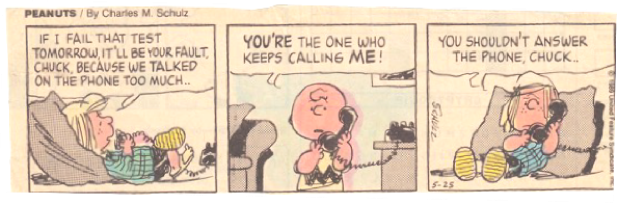
ASSUMPTIONS ABOUT MY EAR
The first step in building a house, car, bridge, or tunnel is to make a sketch of what you want. Next refine that to a blueprint or model made to scale which will be used to actually guide the construction of what you want. If the blueprint is incorrect, this will be reflected in the end product. This is similar to baking and cooking, the recipe is the guide to the end product and we need to follow the sequence, time, and temperature in order to obtain the end product. In our behavior, i.e., creating our experience, we are operating on the basis of our assumptions, a little like blueprints and models. If you are enjoying your life that would suggest that the assumptions you have been using are serving you well. If you are doing unhappiness, bitterness, worry, anger, resentment, etc., that would suggest that your assumptions are bearing bitter fruit, and maybe time for a change.
I would like to share a perfect example that will illustrate what I am getting at. In my early 60’s I had fluid in my ear. My internist first assumed it was an infection so he prescribed some antibiotics which had no effect, except perhaps to decimate some of my useful flora. Faced with that non-result, he said I likely had serum otitis. He explained that the lower end of the eustachian tube connecting my ear drum to my throat had a valve that was not functioning correctly. The result was a partial vacuum that gradually filled with serum from the blood and pressed against the ear drum reducing its ability to resonate, thus reducing my ability to hear. His recommendation was to refer me to an ENT physician and get a tube installed.
Off to the ENT doc that resulted in the following: first a shot in the ear which was momentarily very painful, next a scalpel cut in the ear drum; suctioning the serum out; inserting a small tube. My next question was is this a permanent solution? He indicated that in 6 to 10 months the tube would be forced out and the eustachian tube would refill and I would need to go through the same procedure. I asked if surgery would repair the valve and he said that he would not recommend it since there was a low probability of success. I also inquired if he had any patients that had recovered from this process and he said none. Over the next several years I had about a dozen similar procedures and fully expected to continue this routine as long as I lived.
Then there was serendipity. I changed my insurance to an HMO and needed to go to another EMT specialist when my eustachian tube had filled again. He did the same procedures and said that he would see me in a few months when my tube fell out and I ended up with serum otitis again. On my next visit he said that he wanted me to try something and asked me to take a sip of water and as I swallowed to hold my upper nose and try to clear as if I had just debarked from an airplane. Lo and behold, it worked! The fluid in my eustachian tube drained immediately! He went on to say that if I cleared in that manner once or twice a day, I would never need another tube.
I mentioned that my previous ENT had talked about a valve and things would never change. His response was that there was no valve, it was simply a matter of the throat end of my eustachian tube had partially collapsed and my daily clearing would take care of it. I thought of hugging him because of the delight I was doing when I envisioned the future without the time, pain, and cost of unending procedures. A different set of assumptions with immediate positive benefits. I have not needed EMT visits for the last dozen years!! A change that was quick, easy, simple, enjoyable, and very beneficial!! All due to a change of thinking about assumptions.
SO WHAT?
I am suggesting that our interpretive framework, decoder, mind set, or map of reality is based on the assumption that we are the doee, not the doer in our emotional behavior. As I wrote before, this is a left over from our childhood when we were operated by the giants in our environment— and we had no choice. Now as adults, we are stuck with choice, no choice about that. And we use our choice robotically to play the part of the victim, as in somebody else made me mad or glad, not that we choose our experience.
This unaware choosing of our behavior is not the result of stupidity, but rather an automatic choice like folding our hands or putting the same leg into the slacks first the same way that we did when we were children.
Operating from the mind set implicit in the sentence–due to circumstances beyond my control, I have been left in charge of me—we can change our mind (thoughts) quickly and easily.
Revisiting some of the examples of implementation, we can “see” the beneficial result of a very different assumption—that of ownership! Bill, Jr. had thought that his father made him angry by telling him what to do. In the middle of that thought, he chose a different thought, that his father was not in control of his thinking and emotions. Bingo, the result was operating himself from the driver’s seat instead of the back seat with his father driving. When the problem was “out there,” (his father), then the solution was out there as well and he would have had to wait until his father changed. Realizing his responsibility (response ability) for his choice to do upset, he could easily and quickly change his emotions.
Ruth thought that she had to “overcome” her nail biting when all she had to do was nothing. Burt thought he had to gain control of his temper when all he had to do is interrupt his buildup with the thought of the priest or Marcia cartoon. Ralph had typically thought that something like a soda spilled in his car made him furious and the thought of using his freedom differently resulted in a tectonic shift in his behavior and feelings. Ellen thought she had no control over her reactions to any hint of abandonment and when she thought about her shoe she brought herself into the adult now. Sue thought her daughter’s request for water was an imposition until she used her freedom in a more positive manner and thought about smiling. Joe thought that he couldn’t stop smoking unless his wife stopped also. When he explored lighting up with a five dollar bill, he ventured face to face with the thought that he was in control and was stuck with choice. Sally thought she had no control over her worry since her mother was her model. When she thought about off loading the job of worrying to her friend she thought of smiling since it seemed so ridiculous. Thus she replaced worry thoughts with smiling thoughts.
So what do you think? What are your thoughts about this BS you have been reading? Remember that I suggested that we did not have thoughts as infants, that we gradually created a mind, a mind of our own that we own.
Also, I suggested that our thoughts are a combination of video, audio, and feelio. Further, that we only sample the external world and then construct an internal “reality” that we assume matches the outside world.
If the external world “drove” the internal world, every person would have the same picture and we know that there is too much variety for that.
One of the eastern gurus made up an interesting analogy. He asked people to go back to their youth and imagine lying on their back in the summer time, watching big, white, fluffy clouds. As we look we can imagine that some of the clouds look like an animal or a profile of a person. Think about the attitude or how we regard the ever changing show. We seem to be interested observers or curious witnesses. However, we are not invested in keeping the image or getting rid of something that looks like the head of a wolf. We know and accept that the canvas will keep shifting. Then he asks the question—what if thoughts were clouds in the sky of our mind? Constantly shifting and changing and we are not focused on trying to control, but rather doing curiosity as we observe.
There is a huge difference in the following two positions: Thoughts and emotions are running my life or I am in charge of my thoughts and I can change my thoughts and feelings quickly and easily, like changing the TV channel. Ann was focused on her husband’s infidelity and stated that she couldn’t stop thinking about it. Of course, she was right. Result, no change. Ellen had an early traumatic experience color her adult relationships. She could not get rid of her history, however, she could neutralize that memory in the now by thinking of her present day shoes. George and his wife utilized thinking about some of this BS in a way that they could go on, not because they would forget and be casual. There was still the tragedy of the daughter’s death, however, they were not going to make a further tragedy out of their lives. Nell did an amazing job of reducing the impact of her rape on her well being. She used her awareness of being in control of her thoughts and feelings to minimize what could have been years of suffering and a social and sexual withdrawal.
FIRST AND SECOND
Sometimes students and clients will “accuse” me of saying that the environment (E) doesn’t matter, that the mind is all. I have never implied that the world outside our skin is of no consequence, although you may have inferred that. In a classroom I will go to the board and write, The E is very important, even underlining very. During our infancy and toddler hood, the E is crucial to our survival. In addition, since we have not yet developed our mind, we are not doing much in the way of thinking or thoughts. As we go about the business of constructing our mind we develop a sort of “map of reality” that is our internal representation of what is going on inside and out. We create the mind sets that I pointed out in the second paragraph in the comments about the homeless man finding a considerable amount of money and you probably took a position of fool or hero with very little information. In a sense we form the blueprints or a model for our adult life. And I would like to remind you of the importance of presets, models or blueprints as illustrated in my discussion of my ear.
I am proposing that one of the fundamental building blocks of our early mental development is that we are at the effect of the environment, especially the giants called parents or caretakers and later other people. We are not in charge of ourselves. Others make us mad or they make us glad. In a way this is similar to my dealing with fluid in my eustachian tube, I needed outside help or intervention when the assumption was a faulty valve. I was not in charge! What a wonderful outcome when a different model or preset resulted in my being able to clear without help, sort of a flip to my being in charge of me which led to a quick and easy change.
As an adult, if you have been left in charge of you, you would be choosing what you thought and what you felt about the E. Imagine the benefits. If you chose upset, you could change your mind immediately and easily without having to wait for others to change first—like Bill suddenly testing the idea that his father was not making him mad, only inviting him to feel like a child being lectured. Ralph dissolved the rage he had initially chosen and replaced it with appreciation and relief that he was not at the effect of a spilled soda in his pristine car. He continued his positive approach during the clean up process when he normally would be cursing and throwing things.
Now back to the statement that the E is very important. I would return to the board and place a number 2 in front of that statement. Next I would put a number 1 above it and write the following sentence. Your thoughts about the E are more important, because what you are experiencing is your thoughts about the E, not the E. If the E were in charge everybody would experience the same thought and feeling instead of the variety among people that we see. Consider this an invitation to spend a few days playing around with these ideas. Use your imagination to pretend that you are in charge of your feelings, that you are doing the choosing, in contrast with the typical norm (or pretense) that others make you feel one way or the other. Remember the ”self” sentencing, if you say you can’t imagine, you will be right. However, if you test drive this very different model, you might end up doing delight.
The words imagination and pretense probably sound pretty whimsical to you if you have absorbed the dominant cultural norms of our puritanically derived heritage and operate your self pretending that other people “make” you feel what you feel. Most people likely would be like Burt who was “trying hard” to control his temper (when other people set him off) instead of simply interrupting. As I mentioned before you can’t get out of a hole by digging it deeper. Also, you can’t get out of seriousness by doing more seriousness.
My suggestion is to put down the shovel, lighten up and play with the following idea. First do something to remind your self that you are in charge and that you can change what you do robotically. For example, if you are wearing a watch or bracelet, switch it to the other wrist for a period of four or five days. This is a simple switch that you can do even if you have been placing it on your left wrist daily for many years. You are likely to find it awkward, but not “hard,” which is always a good sign of change similar to when you are learning a new dance step. You may do startle (not be startled, as if you are not in charge) when you look at the left wrist automatically for the time and “find” the watch missing, another good sign that you are getting familiar with your roboticism.
At this point you may be saying that you don’t wear a watch and I suggest you either borrow one or retrieve one you formerly wore. If you want to substitute some other daily activity that will give you a chance to experience your automaticity, awkwardness, and ease of change, that is great. Remember to “play” with this, don’t do seriousness.
During these few days of exploration, pretend the following, that you have chosen impatience when you are put on hold in a telephone call. When you start to do upset about another driver, pretend that you chose that reaction. When a clerk or a waiter is inattentive or snippy, pretend that you chose your reaction in contrast to your usual way of pretending that the other person pissed you off. If a coworker is abrupt in her/his dealings with you, pretend that you chose your hurt or anger, not the coworker. Also, on the positive side, if a coworker says something humorous and you laugh, pretend that you chose to laugh, that he/she did not make you laugh.
If you do this little bit of oddball behavior, you may feel a little silly at times (pretend that you chose to feel silly), maybe a little worried (you chose that, too) that you are not facing the “real reality” that is the norm. What you may “discover” or make up is that you are creating a lighter version of your own life, realizing the benefits of utilizing your internal sovereignty in a delightful way. Delightful because by pretending or assuming that you are the operator, you can minimize any time on the burner and maximize your time on the velour. In video, audio and feelio terms, when you feel the heat or hear and feel the rumble strip, you can simply and easily smile and steer into smooth.
I want to state again that others are sovereign as well, so you cannot make them laugh or mad, they will choose, so you don’t need to worry about that. In addition, you cannot convince anybody else, nor can you teach, motivate, or influence them, it will always be their choice, not yours. In this BS version, the chain of command is one, you are at the wheel of your vehicle. Worrying about other people’s choice to blame you for their upset is a burner you don’t need to spend much time on. It will be a relief to skip doing guilt about others’ attribution of your being the cause of their distress, since they chose it. This does not mean that you will be indifferent to others. Since you are more effectively selfish, you will be more gracious and a better listener, as well as treating them with respect. It would seem that when we are not treating out selves well, that is the time when we are more likely to be short with others.
Although you already know what I am going to remind you of, I would wager that you have not thought about what follows for a long time. What I want to point out is that after becoming an adult, you have chosen every single step you have taken as you move around. You have been in charge of the bites of food you have taken in. You have decided how many times to chew your food once you have placed it in your mouth. You have chosen what clothing you have purchased, and you are wearing what you chose earlier today right down to the shoes on your feet. When you drive you make thousands of decisions, choosing to lighten or press on the accelerator, give the steering wheel a little adjustment, etc., mostly in automatic pilot mode outside of your awareness. You have chosen what you say, not only to other people but to your self also, as in thinking and self reflection. Lots and lots of choosing. When I reflect back on my smoking behavior, I chose every cigarette that I lit up while pretending I couldn’t stop. I’m glad I changed my mind and kept the change.
Why did I go through this list of everyday activities that we take for granted? I wanted to point out the contrast between what we started with (a helpless and totally dependent infant) and the adult who has developed and mastered all these behaviors. How can we logically think that our emotional behavior is exempt from that ownership?? As I stated earlier I think this is a leftover from our early years of dependency and lack of role models regarding emotional ownership. Operating our selves from the position that others are responsible for our emotions is simply a norm that leads to victimology. Speaking of norms, the new norm (majority) regarding weight is obesity. I was a member from time to time until I changed my mind, now I am in the minority. I hope you change your mind about emotional ownership through pretending you are in charge—if you happen to be in the majority of playing life from the position of being an emotional pawn.
DOING THE BEST
I am going to add another presupposition beyond the one that each person is operating one unit, themselves, and that is: everybody is doing them selves the best that they know how. They may not be doing them selves delightfully but that is only because they are unaware of better ways of conducting themselves. Everybody has the potential, however, they may be operating as if the Puritans had the template for how to live life and they are living in that illusion. It is a two way street, you cannot change them and they cannot teach, convince, motivate or influence you. Living in this alternative illusion naturally results in respecting others as well as respecting self.
I will also add that if this silly BS is too far out for you, you are free to stop reading and put the watch back on the familiar wrist and go about your life thinking that you are at the effect of others and conditions of the E. I have written all this in an invitational mood and you get to make up what ever you want. When you get an invitation to a function, “it” does not cause you to attend or even respond. You will chose your response as well as deciding if you will RSVP, or not. Plenty of people do not respond to a court summons (invitation) for a traffic violation. The buzzing, blooming world outside our skin is a series of invitations that invites us to choose our reactions, a stark contrast to our newly born status when the E had no meaning to us, yet vital to our survival.
Earlier I underlined imply and infer, suggesting they can be quite different. When I hear somebody say, “I know what you are implying,” I suggest that is inaccurate because that person can only know what they are inferring (making up). Imply and infer can be very similar, although unlikely to be a mirror image, and they can be miles apart. In the political world, the focus is on the “spin” put on somebody’s comments seemingly with no awareness that the “spin” the listener or reader brings to bear is acknowledged and is even more important. This is a little like the accent is usually attributed to the speaker with little awareness that the listener has an accent in their listening.
Another aspect of this common illusion is our impotence with regard to our children. We are very potent physically when it comes to providing food, shelter and clothing for our children. However, we cannot get in their mind, that is private space. They will select, infer, or make up what they choose. I mention this because a lot of parents are turning themselves into pretzels trying to do something impossible. “Helicopter parents” are not preparing their children for adult life. I read about books and pundits who tout methods to build self esteem in children. One can be a role model, and one can treat their children with respect but they cannot teach, convince, or influence the child’s self esteem, much to the chagrin of Freud and his followers who have spent hours listening to their patients blaming their parents for all their current troubles.
Self esteem is my story about me and your story about you. The esteem you may hold in your view of me is other esteem and it does not “transfer” to my self esteem. If you have ever tried to convince somebody who is doing low self esteem, that they are worthy, you have had a chance to recognize your impotence. What you may find out is that the person you are trying to convince may attempt to convince you that you are wrong in your evaluation or that you don’t understand. Very interesting!
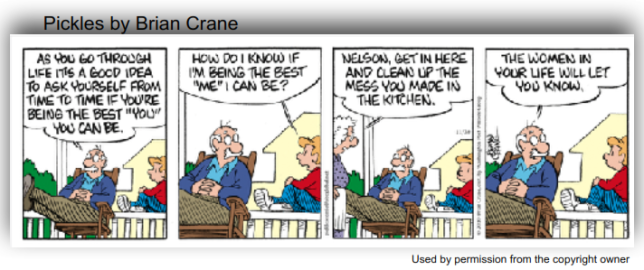
SPIDER WEB
If you have read this far, you may have developed some issues with the way I write. My style is similar to what is known as a narrative or stream of consciousness, or worse yet, poorly organized, not to mention redundant and repetitive. Of course, if I were you, I would have those same thoughts, however, if you were me, you would write in this style. By the way, I did not cause your judgment, you chose it. However, I would not argue with that perception. What I have attempted is similar to a spider web. All the various comments and stories and comics may seem like tangents, however, they are all connected with the central thesis—
Due to circumstances beyond my control,
I have been left in charge of me.
—one unit or vehicle with me at the wheel. I am suggesting that is the case for everybody who is reading this. It is not the case for infants, toddlers, and young children or people with severe mental problems, who by the way are not reading this. This BS is also not relevant to the people starving in the third world.
It is relevant to somebody like Stephen Hawking, the paraplegic who cannot speak except through a computer assist. He has gained renown for his writing in theoretical physics and he would probably agree that he is making up all his speculations. From my perspective, all the threads of the web are joined together. I have already confessed that I am making up what I have written and what I am implying. I invite you to join me in your inference. I also know that it is unlikely that I will ever know what you are making up about this BS.
Further, you will never know everything I am implying. This communication business is very sloppy. Various words and statements can have different meanings.
WHAT DOES EVERYBODY WANT?
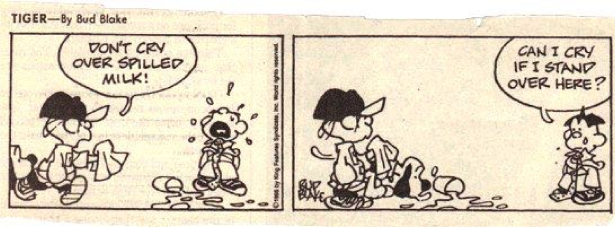
I remember a statement that goes something like this: All I want is a kind word……and, of course, unlimited power! Sometimes you may have to supply the kind words to your self. As to unlimited power or choice to operate your self, you are stuck with that already, you have no choice about that. And the people that you are interacting with are in the same condition, yet we live in a world where many people are wasting their time and energy trying to teach, convince, or influence another so they, the person who is trying to do the convincing, can feel good (vindicated). In other words, their happiness seems to be contingent on others even though those others have no leverage for “making” that person happy, or unhappy. The best you can do is invite-—and this web is my invitation to you to use your internal sovereignty in a constructive way for you.

I ran across a comment that I would like to share. If you think the grass is greener on the other side of the fence, maybe it would be a good time to fertilize and water your own plot. If you have used your self mastery to create an issue with alcohol and other drugs only you can cease and desist. There is no help that can do it for you. If you have put in too much or too little food and drink (obese or anorexic), it is up to you to remedy the situation by eating less or more. (I have been there, I gained and lost 30-40 pounds several times and also imbibed enough that I could pass for an alcoholic. Fortunately I awoke to my ownership many years ago and simply made those issues disappear by eating and drinking less.) There is nobody that can do that for you, you cannot outsource your behavior. If you are spending a lot of time on the burners —doing worry, guilt, anger, hurt, depression, etc., it is up to you to remove your hand. Nobody can do that for you, or even help you. I know this is not typical thinking, however, it is based on the notion that you are running your life. That is the center of the web and there are bumps in the road but no place for alibis.
I mentioned the dis-ease, anorexia, and I have had relatively little experience dealing with somebody who is doing that-(2), however, I think there are many, mostly women, that are involved although the percentage in the population is relatively small. What is striking is the dedication to being thin in spite of the visual information reflected in the mirror, almost like a form of blindness. They look in the mirror and see fat instead of skin and bones, some all the way to their death. In my interaction with the two women who were my clients, I was sure that they totally believed they were fat and that eating a few greens was the way to reduce and both did not create any value from our few meetings. They were immune to any input from me, partly because I was a male, and did not know what I was talking about when I talked about being in control. They were single minded in control, eat less, get rid of the fat. The reason I mention this topic is to point out that the mind trumps all else and I want to say something about a much larger segment of the population, the majority who are obese.
What I am referring to is that the norm in this culture is a sort of “blindness” in regard to our ownership regarding weight. The individual knows that they are overweight and clearly experiences the difficulties that result: hard to find clothes, tie shoe laces, fit in an airplane seat, etc. Typically, there are considerable lamentations about their situations, short runs on a variety of short lived “diets” which “never work” followed by resignation and often more eating. This describes my approach for years after I left the military after the Korean War. My mother was obese during most of her life and my only sister was morbidly obese which led to a relatively early demise so I had an exposure to overeating and struggle with weight. I have convinced my self that this is not a matter of stupidity or lack of intelligence, rather an unawareness of our ownership plus the puritanical culture we have absorbed. My mother was operating from the model that can be summarized as: We are put on this earth to suffer to get ready for paradise in heaven.
People know how to gain weight by eating more, thus they know that to lose weight they have to eat less, a case of doing nothing or no thing about a portion of the food they usually eat. I’m not talking about fasting, just eating half or two thirds of what they usually eat (and doing nothing about the other half or third) over a period of time will result in weighing less. Somehow most will make that difficult (suffering builds character, nothing worth having comes easily) rather than labeling the change as awkward, moving toward a “gift” to them selves. I might add there are many who would say they like being fat, sometimes almost militant in their defense of their position, never mind the health statistics.
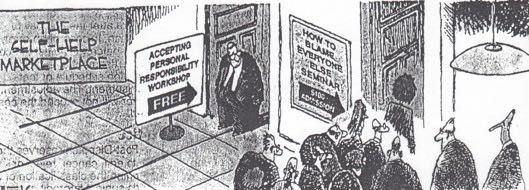
I apologize for the poor quality of the comic so I will describe it. The picture shows the entrance to side by side auditoriums. The first entrance pictures people in line to hear the topic, “How to blame everybody else” for a fee of $100. I would add how to blame everybody else AND everything else like my upbringing, my lack of willpower, my big appetite and other alibis. There is no line at the other entrance where the title is “Accepting Personal Responsibility” and it is free with the presenter standing at the door waiting for anybody to come in. I would change that sign a little by erasing accepting and replace it with understanding you are stuck with personal responsibility! You cannot accept what you already have. I would also split the word responsibility to personal response ability. The majority do frustration about their inability to change others while thinking that other people are “pushing their buttons.” When I hear client’s using that phrase, I ask them to show me the buttons. Their response it that they are not real buttons so I guess it is all in their imagination. Where else?? In my view the only person that can touch those buttons is self.
I once heard the following statement: constructive criticism is not very appreciated from family, neighbors, acquaintances, friends, coworkers, and complete strangers. Much of the time it is resented and even is a preamble to an argument. In spite of that result many people persist in their attempt to correct others. My suggestion is take a break or a vacation and save your breath to cool your soup, especially when you review the great benefits of previous dust ups.
One more area to cover before I stop making up this BS, at least writing about it. It is something I read from a book by William Glasser. It is important to find the best partner you can find for marriage, however, it is even more important to be the best partner that you can be. Sounds a lot like taking care of your own plot—and other people cannot stop you from making it green. P.S. MORE B.S.
I would like to add that if doing worry, upset and angst paid off, I would be inviting people to do more suffering. As Calvin’s father said when he was telling Calvin about life, “Yes, life is tough, suffering builds character, nothing worth having comes easy.” Calvin’s response was ”ARGGHH!” You can see how this puritanical thinking frowns on ease of change and results in many of my clients and students saying you make it too simple or you make it sound so easy and life is not easy, so I can’t use what you are advocating. This reminds me of a quote I would like to share.
One of the paradoxes of life is that the more one is anxious to survive, the less survival is worth the trouble. On the other hand there is a considerable and normally unexpected survival value in the very absence of the anxiety to survive.
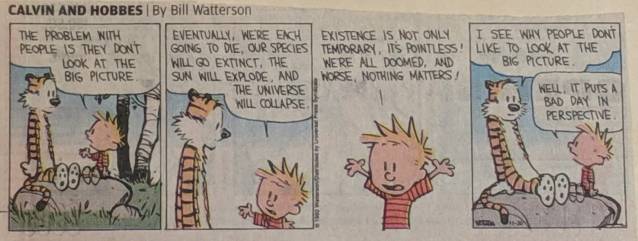
A close runner up to that is,
Facts, however, do not speak for themselves, they depend on the voice of the ventriloquist that holds them.
Some affirmations you might find useful are:
I feel warm and loving toward myself…..
I am a unique and precious being, ever doing the best that my current awareness permits…..
I see myself bathed in the white light of energy, with love in my heart, health in my body, wisdom in my mind, laughter in my attitude, and serenity in my spirit.
If you have been ineffectively selfish, these comments may sound pretty fru fru and inapplicable to you. I suggest you test drive them for a little while and you may dissolve the awkwardness that you feel and be more friendly to your self.
**********
If you have read this far you have created many reactions, interpretations, thoughts, and judgments about these inert words. I would guess that you have presets that may have resulted in the following: redundant, poorly organized, wandering, overly simplified, too cutesy, repetitious, unrealistic, to mention a few. You can add others. I agree this epistle is not incisive, it approaches story telling and what I have been sharing is my opinion and I think you may benefit from reiteration. I want to remind you that if you were me, you would have written it in exactly the way I have done. And, if I were you I would have written exactly as you would have.
I can present a “bare bones” version:
- You have been left in charge of you. Therefore you make all the decisions involved in operating you, including what emotions you choose to experience.
- You make most of these decisions outside of awareness (on autopilot) based on patterns from your early development.
- You can change your thoughts and feelings quickly and easily.
- It’s your choice!
How is that for brevity?
I think that a poetic approach, that is also brief, may be an excellent invitation as well as a summary of what I have been writing about. It was written about 150 years ago and I see it as relevant today when the focus is thinking about thought..
As a Man Thinketh by James Allen
Mind is the Master-power that molds and makes,
And Man is Mind, and evermore he takes
The tool of thought, and shaping what he wills,
Brings forth a thousand joys, a thousand ills:–
He thinks in secret, and it comes to pass:
Environment is but his looking-glass.
I’ll follow this up with poem of unknown origin.
Thoughts About Thinking
If you always think what you’ve always thought,
then you’ll always feel what you’ve always felt.
And if you always feel what you’ve always felt,
then you’ll always deal what you’ve always dealt.
And if you always do what you’ve always done,
then you’ll always get what you’ve always got.
Here is my addendum: If you don’t like what you’ve always gotten, go back to the beginning and use your mind for a change in your thinking. If you create something of value-—keep the change!
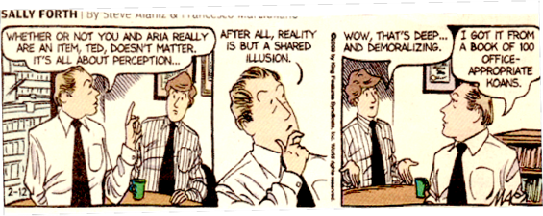
There are many more stories and implementations; however, I think the web has been adequately outlined and described. Please don’t take me seriously, I would recommend lightly instead. So, like Donald Shimoda said in Illusions, “I choose to leave you now to go your own way.”
And I would add from Calvin and Hobbs, using your freedom to include “more special effects and dance numbers.”
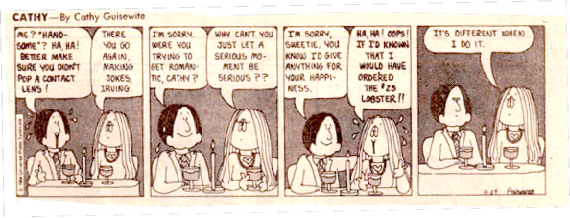
I just ran across an article that quotes a coach talking about the mental part of the game. He states, “The mind is the gatekeeper of the body. Right thinking is a skill. You can identify it. People miss the fact that confidence is just a thought. It’s not a thing. You don’t store it up. You don’t get it today and have it Saturday. It’s a thought. And every thought that you have (I would substitute do) is a choice. If you’ve got a thought that you don’t like, pick something else.” Well said!!
I recommended to Mr. and Mrs. Tall Short, couple who argued a lot, that as soon as they realized that they were at the beginning of an argument, the husband was to get on the floor and present his thoughts from that position with his wife standing next to him. This piece from Dear Abby was met with a smile from both of them.
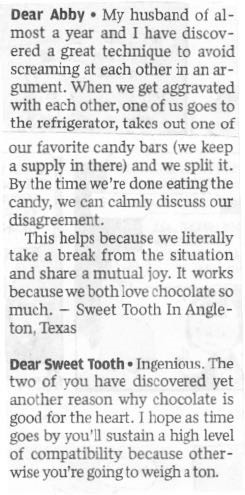
What is basic is the early interrupt, whether by position (even the thought of a different position) or by sharing a candy bar. The writer says “it works because we both love chocolate so much. I think it is just a case that they do something else (could be just about anything else) instead of going to the mat and screaming at each other.
Of course, one can go to the other extreme and stonewall as in this comic by Brian Crane in one of his un-comic Pickles comics…

Here is another from Dilbert.
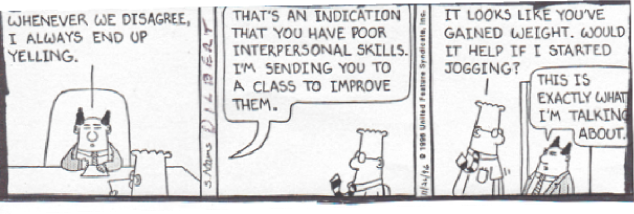
If you have read all this BS, I would welcome feedback from you, both positive and negative. If you have used it to create value for your self, please write about your “I turn” so I can include it (if you give me permission) when I write some more. If you have created value for yourself from this, please forward it along to others who might be interested.
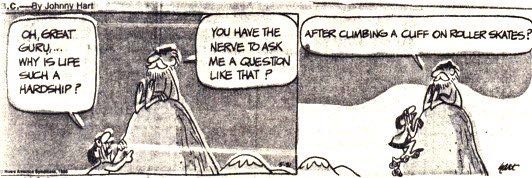
Sometimes you don’t need words.
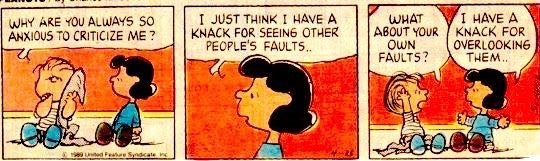
THOUGHTS from a PSYCHOLOGIST
© 2017 by Marlowe O. Erickson


 Thoughts Marlowe Thought